The rise of low-code and no-code development platforms is reshaping how we think about building applications. These platforms are marketed for their ease of use, emphasizing that even those without coding expertise can quickly create applications. This approach to app development is increasingly popular because it democratizes the process, making it accessible to a broader audience.
One key advantage of low-code platforms is their ability to empower people with little to no programming knowledge. They can now bring new projects to life or develop fresh ideas independently. Traditionally, creating an application involved relaying ideas to a programmer or coder, who would then try to translate these concepts into a functional product. This process could be time-consuming and often result in a product that might not fully align with the original vision.
However, with low-code and no-code platforms, this dynamic has changed. Individuals can now take control of the development process, building and adjusting their applications as they see fit. This hands-on approach allows for a more accurate realization of one’s vision and fosters innovation by removing technical barriers.
The simplicity of these platforms lies in their user-friendly interfaces, which often involve drag-and-drop functionalities and easy-to-navigate design elements. This means that making an app doesn’t require writing lines of code. Instead, it’s about visually constructing the application, piece by piece, like building a model using a kit.
As these platforms evolve, they’re becoming even more intuitive, making app development not just accessible but also an enjoyable experience. This shift is significant in an increasingly digital world, where the ability to quickly develop and deploy applications can be a game-changer for businesses and individuals alike.
In summary, low-code and no-code platforms are not just a trend; they represent a fundamental shift in the digital landscape. They’re opening doors for creative minds to develop their digital solutions without the bottleneck of needing advanced coding skills, thereby accelerating innovation and personal empowerment in the digital realm.
Welcome to today’s podcast! I am thrilled to have a special guest, Dan Hafner, an expert in app development without traditional coding. Dan started with no coding skills but established a successful app development business. He specializes in helping coaches, content creators, and entrepreneurs transform their ideas into practical, stylish, and scalable apps.
Dan Hafner’s journey from a novice to a guru in the no-code app development space is truly inspiring, and his insights are invaluable for anyone looking to enter this rapidly evolving field.
Episode # 125
Today’s Guest:
Dan Hafner, Founder, Dapper Mobile Apps
- Website: DapperMobileApps
- Facebook: DanHafner
What Listeners Will Learn:
In today’s podcast, you’ll gain insights into several key areas:
- Challenges for Non-Programmers Using Low-Code Platforms
- Getting Started for Beginners with app development using low-code platforms
- Common Platforms for Beginners to start building the apps
- Tips for Building SaaS Applications
Resources:
]]>
Managed services have become a linchpin in the strategy of companies looking to harness technology for growth, efficiency, and innovation.
We delve into the transformative world of managed services and their role in business strategy.
The shift from in-house tech management to outsourcing to specialized tech companies represents a strategic reorientation for many businesses. This critical decision allows companies to focus on their core competencies, entrusting the technological complexities to expert service providers. Yet, challenges arise, especially for tech-centric businesses that prioritize maintaining control over their IT infrastructures.
We explore this delicate balance between managing in-house technology and reaping the benefits of outsourced services.
This blog post and accompanying podcast are tailored for business leaders contemplating the shift to managed services and MSPs aiming to align their services with client success. Stay tuned as we navigate the dynamic and evolving landscape of managed services and AI applications in business.
Episode # 122
Today’s Guest:
Dave Sobel, Host of the Business of Tech podcast and owner of MSP Radio
- Website: Business of Tech
- Youtube: MSP Radio
- Twitter: MSPRadio
What Listeners Will Learn:
In today’s podcast, you’ll gain insights into several key areas:
- Choosing the Right MSP: We discuss how selecting a managed services provider (MSP) goes beyond technical capabilities and involves making a strategic business decision.
- Acquiring the Right Talent: Tackling the crucial question of talent acquisition from outsourced providers, we weigh the pros and cons of direct involvement in the selection process versus trusting the expertise of MSPs.
- Meeting Business Expectations: How are companies’ expectations of MSPs being met, and what improvements can be made to these partnerships?
- Evolving Landscape of Managed Services: Examining current trends in the managed services sector to understand whether their prevalence is increasing and how this impacts business strategies.
- The Role of MSPs in Client Success: Delving into how MSPs can ensure their clients achieve success and support them in their business journey.
- AI in Business: Understanding the application of AI, especially Generative AI, in business, its strengths, limitations, and scenarios where it may not be the ideal solution.
Resources:
]]>
Digital transformation of leaders is a crucial area ignored or not considered at the business transformation programs agenda. Digital transformation requires top to bottom organizational change, which requires digital-savvy leaders and knows how to lead the digital programs. All programs are focusing on the digital transformation of the business or an organization. However, significantly less focus is on the readiness of leaders of an organization. It is leading to a lot of challenges in the success rate of business transformation programs.
Few months back, on a similar topic, we had a session with the title of ‘What is for ‘me’ in Digital Transformation? (otechtalks.tv)’ part 1 and ‘What is for ‘me’ in Digital Transformation? Part 2 (otechtalks.tv)’ without enough expertise of the leaders, shareholders, owners of the business on the digital area is becoming a challenge, and that’s why I like the article/research done by the MIT Sloan Management Review with the title “Leadership’s Digital Transformation.”
It leads me to ask some fundamental questions to the leaders, few to mention:
- How can leaders explain the vision for digital transformation?
- Do you have a chief digital officer role in the organization? If not, who is doing this role, and what are the challenges, responsibilities, and success standards for that position/role?
- How much of your budget is allocated for transforming the organization?
- Five to ten years from now, how will your organization be different?
Leader’s Traits:
- Leaders need to have top traits that consist of interpersonal skills, cultural knowledge, and emotional intelligence to see the big picture of business transformation. Another essential quality is to have the ability to unlearn and learn so that they can lead the transformative situations required for organizations.
- Leaders need to have a business understanding, taking the right decisions at the right time, focusing on achieving timely executions of initiatives with clear objectives.
- Leaders need to have the right competencies to work freely, autonomously, and with limited involvement from others; however, when required, he is flexible and takes opinions from others. He must have integrity to be authentic, open and flexible, adaptable.
You’ll Learn:
It’s a beginners guide to learn the basics of the ML
- Key findings of the research
- The Purpose Maturity Index
- Traits of the digital leaders
Resources:
- MIT Sloan Management Review “Leadership’s Digital Transformation
- Why digital transformation is now on the CEO’s shoulders
- Open Tech Talk Sessions on Digital Transformation:
- 81- Digital Transformation during and Post COVID-19
- 64- Coronavirus Outbreak: Business continuity & IT Leaders priorities
- 63- Digital transformation expectations vs. reality
- 62- First 100 Days of Digital Transformation
- 61- How to do Digital Maturity Assessment
- 60- What is digital maturity and which digital maturity model to choose?
- 59- Where to start in an organization for Digital Transformation
- 58- A leap from Information Technology to Business Technology
- 57-Architecting an operating model for digital transformation
- 56- A Digital Transformation Framework
- 54-How to make a business case of Digital Transformation
- 53- Human Resources and Digital transformation
- 52- How you will know digital transformation is achieved
- 51- Enterprise Architects for Success of Digital Transformation
- 50- Is there an end to Digital Transformation?
- 49-What is for ‘me’ in Digital Transformation? Part 2
- 48- What is for ‘me’ in Digital Transformation? Part-1
- 47-How to win at Digital Transformation
- 46- Digital Transformation – it’s all about culture
- 45- How to Overcome Digital Transformation Challenges
- 44-What are the challenges in Digital Transformation
- 43-What other Organization are doing to achieve digital transformation
- 42-How do you start a Digital Transformation
- 41-What are the benefits of Digital Transformation?
- 40-Why Digital Transformation is required?
- 39-“What is digital transformation? Learning the basics”
To share your thoughts:
- Leave a comment on the section below on this post
- You want to suggest any new topic we should cover in future Podcast
- Join us in Mastermind tribe
- Share this on Twitter, Facebook, If you enjoyed this episode and we together are learning new technologies.
To help out this initiative:
- Leave a candid review for the OTechTalks Podcast on iTunes! Your ratings and reviews will help the session on iTunes.
- Subscribe to the Podcast on iTunes to get the next sessions
Digital transformation is key during and post-COVID-19 enterprise resilience. COVID-19 forces the biggest acceleration in Digital Transformation. The world has changed post-COVID-19, and we all are going through it. The truth is it will keep changing, and we need to adapt to this, we need to transform our businesses, services to play our role in shaping the ‘new normal of the world – our world. I will start with my own experiences for digital transformation, what I have observed. before starting to this, want to highlight the earlier session we had during April, 2020 on COVID-19 Pandemic and acceleration of Digital Transformation
Last week, I went to the local hospital for my routine checkup. At the reception desk, where usually I have to present the ID card and get the queue number for consultancy, after all the process, the front office executive didn’t give me the token number. Which we use to get on each visit, and then based on this number, you are supposed to go to the concerned doctor’s room for consultancy. Instead of giving me the token she said, you have got it through the SMS, check your mobile number, and that was surprising to me, innovation 
What you, me, and everyone is observing is that COVID-19 as the wake-up call and leaders have to stop talking-the-talk about digital transformation, and they have to start walking-the-walk. Digital transformation has always inspired everyone in the business and the consumer world; however, embracing the transformation has been tremendously slowed in some of the sectors, and in some of the sectors, it was reasonably acceptable. Now the old question, from where the value is coming? During or after business transformation is gone as the organizations started living and showing the results during COVID-19. Now is the time and requirement is so urgent, and those organizations who are not able to transform will become irrelevant and uncompetitive or maybe to put in write words, they will not be in the market.
According to COVID-19 CIO Pulse Survey of PwC Strategy&, COVID-19 pandemic has left no choice for organizations to fast-track the digital transformation.
Top priorities according to survey for 2020 are:
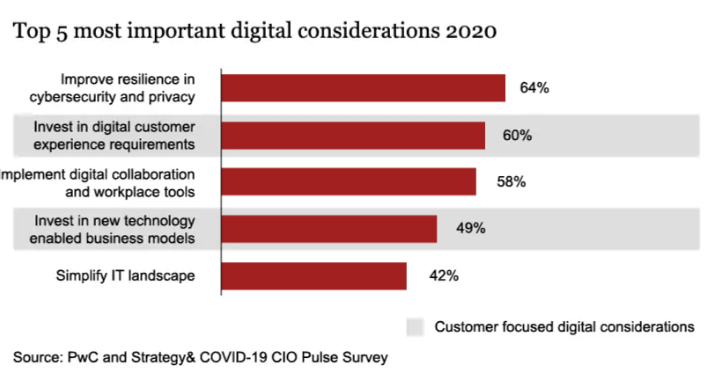
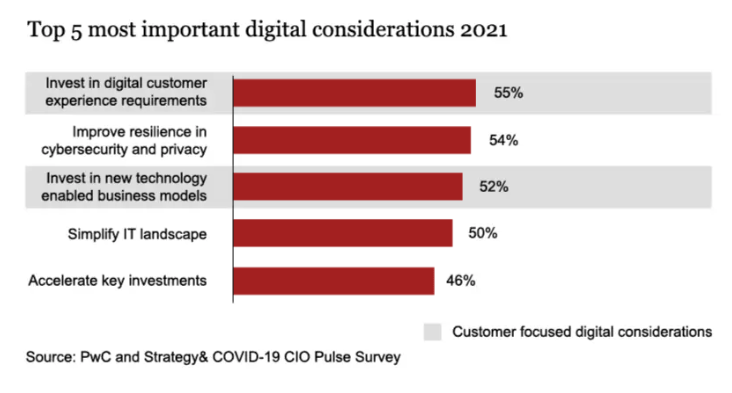
What industry analysts are saying, McKinsey & Company has outlined in the article ‘A road map for post-COVID-19 growth’ the three-stage process; the first stage is ‘navigating the crisis now’, second stage is ‘planning for the recovery’. The third stage is ‘leading the next normal’. In the second phase, the main focus is on how you will fast-track digital transformation activities in your organization. And in these three stages to navigate quickly and rightly, you have to have Tiger teams and SWAT teams of talented individuals selected from across your organization and focused on a specific business mission. Refer earlier session for Tiger & SWAT Teams Coronavirus Outbreak: Business continuity & IT Leaders priorities
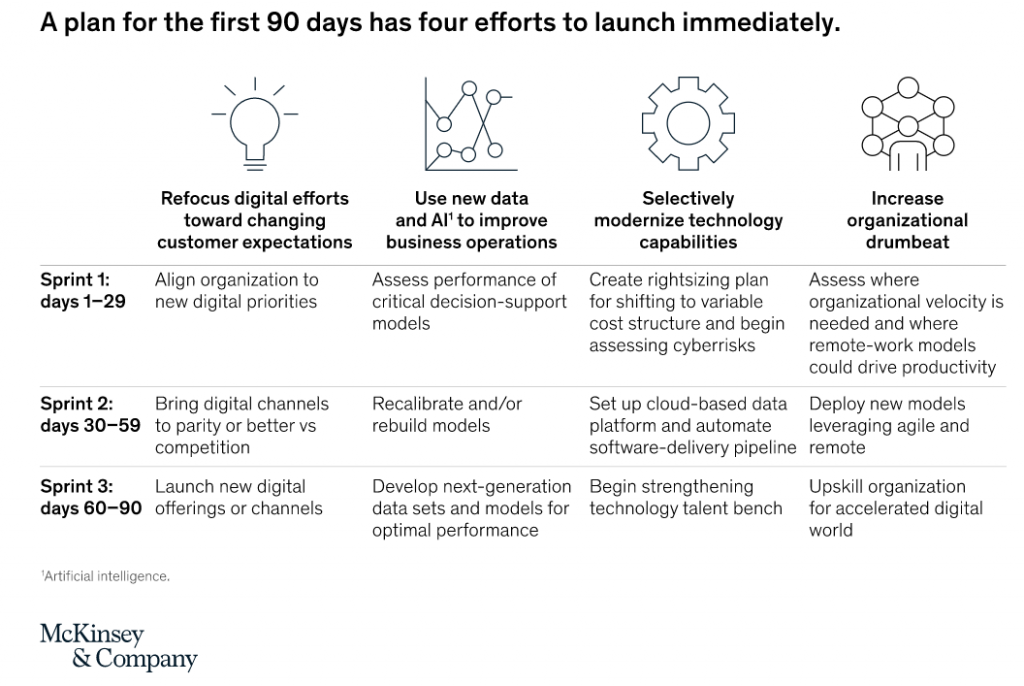
90-Days Plan to Make It Happen
You may have read so many articles on how to plan initial days of digital transformation in your organization and back in March 2020, I have also done a podcast on ‘First 100 Days of Digital Transformation’ However with the COVID-19, the situation is different and along with the recovery planning, I like the article from McKinsey & Company ‘The COVID-19 recovery will be digital: A plan for the first 90 days’ What is your plan for first 90 days on the digital transformation in your organization?
You’ll Learn:
The post-COVID-19 World is Digital
- A Personal experience
- How the post-COVID-19 World is Digital
- Four actions to take quickly
- What you need to to do, 90-Days Plan to Make It Happen
Resources:
- Open Tech Talk Sessions on Digital Transformation:
- 64- Coronavirus Outbreak: Business continuity & IT Leaders priorities
- 63- Digital transformation expectations vs. reality
- 62- First 100 Days of Digital Transformation
- 61- How to do Digital Maturity Assessment
- 60- What is digital maturity and which digital maturity model to choose?
- 59- Where to start in organization for Digital Transformation
- 58- A leap from Information Technology to Business Technology
- 57-Architecting an operating model for digital transformation
- 56- A Digital Transformation Framework
- 54-How to make a business case of Digital Transformation
- 53- Human Resources and Digital transformation
- 52- How you will know digital transformation is achieved
- 51- Enterprise Architects for Success of Digital Transformation
- 50- Is there an end to Digital Transformation?
- 49-What is for ‘me’ in Digital Transformation? Part 2
- 48- What is for ‘me’ in Digital Transformation? Part-1
- 47-How to win at Digital Transformation
- 46- Digital Transformation – it’s all about culture
- 45- How to Overcome Digital Transformation Challenges
- 44-What are the challenges in Digital Transformation
- 43-What other Organization are doing to achieve digital transformation
- 42-How do you start a Digital Transformation
- 41-What are the benefits of Digital Transformation?
- 40-Why Digital Transformation is required?
- 39-“What is digital transformation? Learning the basics”
- COVID-19 CIO Pulse Survey of PwC Strategy&
- A road map for post-COVID-19 growth
- The COVID-19 recovery will be digital: A plan for the first 90 days
To share your thoughts:
- Leave a comment on the section below on this post
- You want to suggest any new topic we should cover in future Podcast
- Join us in Mastermind tribe
- Share this on Twitter, Facebook, If you enjoyed this episode and we together are learning new Technologies.
To help out this initiative:
- Leave a candid review for the OTechTalks Podcast on iTunes! Your ratings and reviews will help the session on iTunes.
- Subscribe to the Podcast on iTunes to get next sessions
I have put together my observations, learning, and experiences into myths about digital transformation. Digital transformation is to solve business problems in an always-changing environment and help organizations to foresee what they want their future business to look like. If you want to lead your organization’s business transformation, the first move is to understand the reality of digital transformation rather than get caught in the hype.
Although digital transformation is a source of disruption for businesses, projecting businesses forward can be easy to misinterpret technologies and be distracted by minor changes in trends and opinions. True disruption means radical change, but common misconceptions about digital transformation result in businesses being sidetracked and misled.
I am working and participating in digital transformations in both government and private sectors across the regions and I have witnessed that in the majority of the cases organizations are making a significant challenging road to Digital transformation. As we are witnessing the Transformation needs to be well-planned, skillfully conducted, and actively supported by the top management.
I have put together my observations, learning, and experiences into myths about digital transformation. If you understand these myths, you’ll be less likely to fall victim to the hype about digital transformation and be more aware of how difficult the process is and how you need to plan it. If you are new to the topic I would suggest you listen to this podcast along with other series of sessions on digital transformation. Till now we have covered more than 30 sessions on the fundamentals of digital transformation.
Lets now dive into the most common misconceptions of digital transformation and technology adoption and we can say busting the Myths of Digital Transformation
You’ll Learn:
Myths and Misunderstandings Of Digital Transformation
- When the technology is applied, the transformation is complete
- Transformation means simply updating the organizations portal and implementing new technology
- Digital transformation is a technical challenge.
- A digital transformation on top of a broken business model or strategy is going to save the business.
- A business can transform without changing how it operates
- CIOs Can’t Drive Transformation, Digital Transformation Requires A Chief Digital Officer
- Digital transformation is only for tech companies
- Every organization should digitally transform
- Digital Transformation Is a Technology Challenge
- Digital transformation only impacts certain markets
- Digital isn’t relevant in my industry
- To succeed, you need to do everything at once
- Digital transformation is meant to disrupt your business
- Digital Transformation and Digitization are the Same Things
- Digital transformation can wait & it is optional
- Every organizational culture is ready for digital transformation
- Digital Transformation has to be expensive
- Digital transformation is a project or single initiative
Resources:
- Open Tech Talk Sessions on Digital Transformation:
- 66- How to develop a digital transformation strategy
- 65- COVID-19 Pandemic and acceleration of Digital Transformation
- 64- Coronavirus Outbreak: Business continuity & IT Leaders priorities
- 63- Digital transformation expectations vs. reality
- 62- First 100 Days of Digital Transformation
- 61- How to do Digital Maturity Assessment
- 60- What is digital maturity and which digital maturity model to choose?
- 59- Where to start in organization for Digital Transformation
- 58- A leap from Information Technology to Business Technology
- 57-Architecting an operating model for digital transformation
- 56- A Digital Transformation Framework
- 54-How to make a business case of Digital Transformation
- 53- Human Resources and Digital transformation
- 52- How you will know digital transformation is achieved
- 51- Enterprise Architects for Success of Digital Transformation
- 50- Is there an end to Digital Transformation?
- 49-What is for ‘me’ in Digital Transformation? Part 2
- 48- What is for ‘me’ in Digital Transformation? Part-1
- 47-How to win at Digital Transformation
- 46- Digital Transformation – it’s all about culture
- 45- How to Overcome Digital Transformation Challenges
- 44-What are the challenges in Digital Transformation
- 43-What other Organization are doing to achieve digital transformation
- 42-How do you start a Digital Transformation
- 41-What are the benefits of Digital Transformation?
- 40-Why Digital Transformation is required?
- 39-“What is digital transformation? Learning the basics”
To share your thoughts:
- Leave a comment on the section below on this post
- You want to suggest any new topic we should cover in future Podcast
- Join us in Mastermind tribe
- Share this on Twitter, Facebook, If you enjoyed this episode and we together are learning new Technologies.
To help out this initiative:
- Leave a candid review for the OTechTalks Podcast on iTunes! Your ratings and reviews will help the session on iTunes.
- Subscribe to the Podcast on iTunes to get next sessions
Digital transformation strategy involves assessing your own requirements and corporate culture, setting business goals and identifying and tracking risks, conducting regular prototypes and testing, asking internal staff for input on these roll-outs, and using new technologies.
For years, the digital transformation seemed like something mostly about computers and software, and data. This is what businesses pursue, for the sake of IT agility, to extract new value from data, model software prototypes of physical goods, or develop business processes.
While such development initiatives are often vital to a company, it turns out that digital transformation is really about us at its heart. That has many powerful lessons to teach us how to think about technology and work, both now and in the future.
The COVID-19 outbreak is a tragedy that will have widespread and long-lasting implications for humanity and our global economy.
I hope you’re all staying safe and healthy. And the way discussion started happening in the organizations and at c-level on the key question. How has COVID impacted & how organizations operate?
These conversations make one point very clear. Business transformation enabled by digital is becoming the new normal as the nature of work is redefined by COVID -19. Delivering education online, shifting banks to digital apps, and accelerating the digital automation with RPA, AI/ML, IoT is now required, without any delay.
The digital economy is characterized by rapid development, change, creativity, and disruption. Organizations that want to keep up must be prepared to adapt to this new digital environment. But digital transformation requires more than just adopting new technologies, investing in fancy gadgets, or updating current systems.
That’s why it’s so important for organizations to have a digital transformation strategy.
You’ll Learn:
Business Transformation Strategy Development
- What is a Digital Transformation strategy?
- What is Strategy? definition of strategy in the corporate world
- How to develop a digital transformation strategy?
- Details on 3 steps strategy approach
- Examples of digital transformation strategy (public sector)
Resources:
- Open Tech Talk Sessions on Digital Transformation:
- 65- COVID-19 Pandemic and acceleration of Digital Transformation
- 64- Coronavirus Outbreak: Business continuity & IT Leaders priorities
- 63- Digital transformation expectations vs. reality
- 62- First 100 Days of Digital Transformation
- 61- How to do Digital Maturity Assessment
- 60- What is digital maturity and which digital maturity model to choose?
- 59- Where to start in organization for Digital Transformation
- 58- A leap from Information Technology to Business Technology
- 57-Architecting an operating model for digital transformation
- 56- A Digital Transformation Framework
- 54-How to make a business case of Digital Transformation
- 53- Human Resources and Digital transformation
- 52- How you will know digital transformation is achieved
- 51- Enterprise Architects for Success of Digital Transformation
- 50- Is there an end to Digital Transformation?
- 49-What is for ‘me’ in Digital Transformation? Part 2
- 48- What is for ‘me’ in Digital Transformation? Part-1
- 47-How to win at Digital Transformation
- 46- Digital Transformation – it’s all about culture
- 45- How to Overcome Digital Transformation Challenges
- 44-What are the challenges in Digital Transformation
- 43-What other Organization are doing to achieve digital transformation
- 42-How do you start a Digital Transformation
- 41-What are the benefits of Digital Transformation?
- 40-Why Digital Transformation is required?
- 39-“What is digital transformation? Learning the basics”
- What Is Strategy, on HBR
- Wikipedia – The term Strategy means something along the lines of a “high-level plan to achieve a goal”
- book On War
- book The Art of War
- book Exploring Corporate Strategy
- book Good Strategy/Bad Strategy: The difference and why it matters
- book Corporate Strategy by Igor Ansoff
- book 10 Must read on Strategy by Harvard Business Review
- book On Strategy by Boston Consulting
- book Leading Change by John Kotter
- book The digital transformation playbook, by David Rogers
- book The Innovator’s Dilemma, written by Clayton Christensen
- Deloitte article Strategy, not technology, drives digital transformation
- Digital Transformation strategy, example Australian government
- Smart Dubai 2021
To share your thoughts:
- Leave a comment on the section below on this post
- You want to suggest any new topic we should cover in future Podcast
- Join us in Mastermind tribe
- Share this on Twitter, Facebook, If you enjoyed this episode and we together are learning new Technologies.
To help out this initiative:
- Leave a candid review for the OTechTalks Podcast on iTunes! Your ratings and reviews will help the session on iTunes.
- Subscribe to the Podcast on iTunes to get next sessions
A digital revolution is underway, you must attend courses on digital transformation sitting at home to become a digital innovator ready to tackle any industry problems related to digital transformation & border technology. Based on three strategic perspectives-Strategic Vision, Organizational View and Business View, Leading Global Transformation and Innovation provides a comprehensive suite of tools to understand and direct you through digital transformation. You must build intimate, actionable plans to address the policy, company and business challenges you face.
These are the 7 courses I personally suggest that you review to understand the fundamentals of digital transformation.
Transform the crisis into an opportunity for growth by using digital technologies and solutions. Battle-tested, experiential knowledge, inspiration and networking for imagination to master disruption. Directly delivered from leading technology & company experts, innovative entrepreneurs and top experts.
The ability to explore transformative technology’s existence and history as you find ways to incorporate key principles and examine how innovative business innovation could fit into new or existing business models.
These online programs provide a hands-on, immersive tour of the industry’s emerging key technologies. Professionals in traditional businesses as well as entrepreneurs looking to take advantage of new technology opportunities should learn about the five biggest drivers of change: blockchain, cloud, AI, IoT, and cybersecurity, instilling confidence to tackle the digital frontier.
- Module includes a series of video lectures on selected topics by different faculty members, followed by more informal discussions.
- Discussion boards are an integral part of every module and provide a platform where participants can communicate with each other, exchange ideas and ask questions.
- Demonstrations and online exercises accompany each module. These serve to illustrate key concepts
1- Professional Certificate in Digital Transformation
The focus of the program will be on developing your own roadmap to digital transformation. The program consists of four courses, all self-paced, which can be followed individually, in numeric order, or in parallel with each other. This course offered by KTH Royal Institute of Technology, is Sweden’s largest technical research and learning institution and has become a key center of intellectual talent and innovation.
(I) course is to analyze what digital transformation means and how it may transform industries and markets.
(II) you will explore how to make strategic choices in a fast-changing environment to develop a desired position on the market.
(III) leadership and change management challenges related to the digital transformation are addressed.
(IV), digital business development and marketing is explored to accelerate the development needed to transform your business/ company.
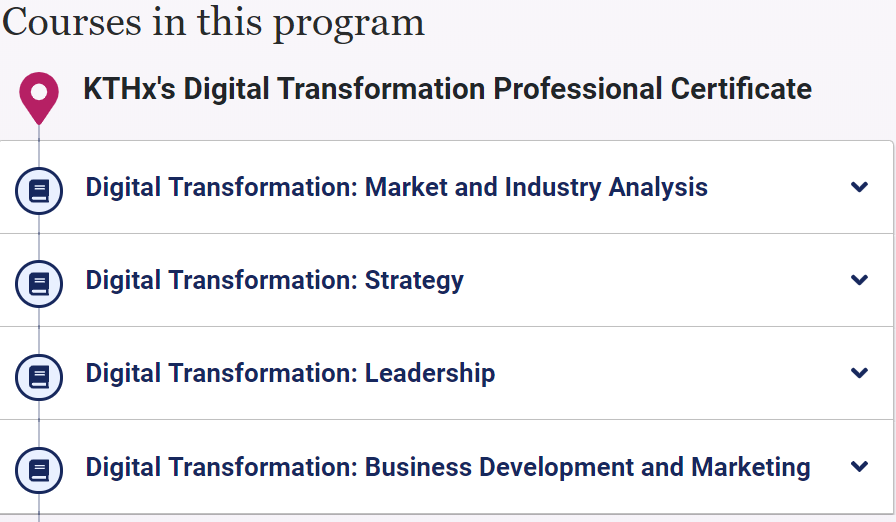
Access Digital transformation professional certificate on edx.org
2- Learn the skills and perspectives of digital leaders
In this Digital Leadership MicroMasters program, you will develop the knowledge and capabilities to lead organizational change and transformation. You will gain hands on experience in understanding and articulating:
- Strategies to drive and transform your business in the digital economy;
- How to drive business value through experimentation;
- Development of platform based strategies for growth;
- Negotiation and management of digital transformation projects;
- Effective people and team management strategies;
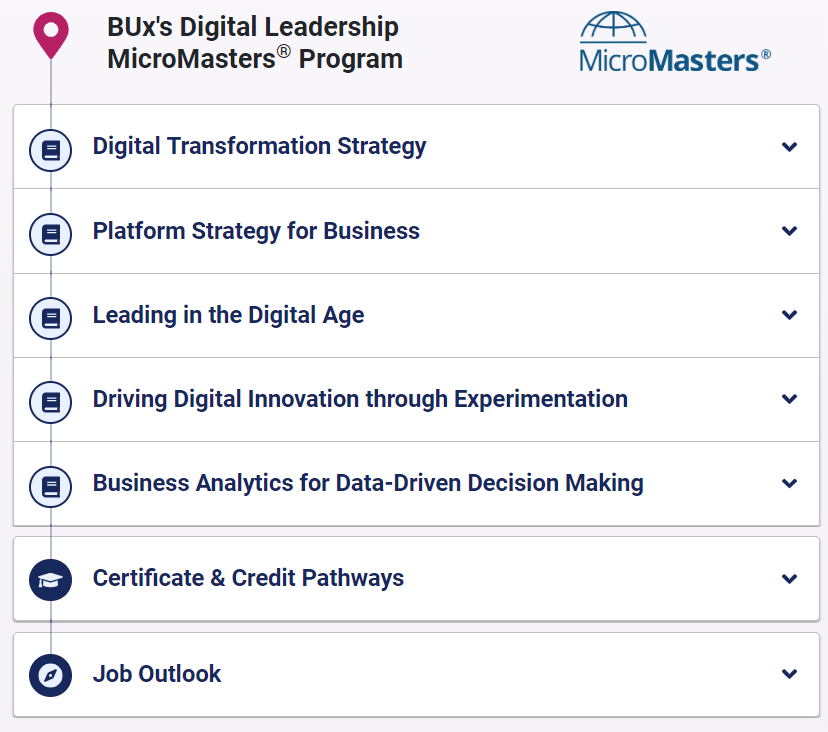
Access MicroMasters® Program in Digital Leadership
3- Digital Transformation in Business
This course will help you assess the most critical digital technologies that affect your business sector and how you can leverage them to realize efficiencies. We’ll discuss when and how to appropriately commoditize the data these technologies produce and ultimately, how the strategic deployment of technology can transform an organization.
Learn about the explosion of technologies that are transforming business and how to strategically leverage technologies to maximize the value–and minimize the risk–to your firm
Access this course on edx.org Digital Transformation in Business
4- Digital Transformation from Coursera
Digital transformation is a today’s topic and what exactly is it and what does it mean for organizations? In this course, we talk about digital transformation in two ways. First we discuss the pace of change and the imperative it creates for businesses. Next we provide the context for this transformation and what it takes to win in the digital age. Then we walk through BCG’s proprietary framework, which helps you identify key areas to digitize, including strategy, core processes, and technology.
By the end of this course, you’ll be able to: –describe the underlying economics of innovation, technology, and market disruptions –weigh the pros and cons of current digital technologies driving advancement –utilize BCG’s digital transformation framework as a “”how-to”” for digitizing your organization
Access Digital Transformer from Coursera.org
I have completed the above 4 courses and I can say that these are very good courses that will give you a head start on the path of digital transformation learning. I have not discussed any of the courses or services offered by so many other schools or universities. You will scan for and find the number of structured courses on digital transformation from highly renewed institutes or universities.
5- All You Need to Know About Digital Transformation
This Digital Transformation course provides an overview of digital transformation that benefits everyone in your organization. It explains the critical factors for any organization to consider as well as the four steps to developing a digital transformation strategy.
Enabling digital transformation throughout your organization requires more than a general understanding of digital transformation, though. Business leaders, IT leaders, and the general workforce require uniquely tailored information to ensure they’re building the right skillsets. That’s why we’ve created these three initial digital transformation learning paths
These course are available on Linkedin Learning and covers following:
- Digital Transformation for Leaders
- Digital Transformation for Tech Leaders
- Digital Transformation in Practice
Access to these courses are available Digital Transformation from Linkedin learning
6- Defining a Digital Transformation Roadmap
This course will help you quickly establish a company wide understanding and framework for defining a successful digital transformation program.
- Define a Phased Digital Transformation Program That Will Establish Your Company as a Digital Leader
- Learn what successful digital transformation requires
- Learn to avoid pitfalls that cause 70% of transformation efforts to fail and Learn how to define a phased program that aligns your company for success
This course helps you understand, communicate and build the consensus required to implement a successful digital transformation program.
Access this course from Udemy Defining a Digital Transformation Roadmap
7- Digital Business Transformation Masterclass
Learn how to approach digital business transformation in a way that can enable your organisation to thrive this decade
Access this course from CXO Transform on Digital Business Transformation
These courses are online and you can attend while you’re at home right now. Nevertheless, there are so many other well-recognized digital transformation programs available from various renowned universities, for example:
]]>
The COVID-19 Pandemic is a crisis that will have far-reaching and long-lasting consequences for society and our global economy. As the coronavirus continues to spread around the world, more and more businesses miss their financial goals due to delays in the supply chain and rising customer demand.
It is also unclear how long this pandemic will last, as there is no vaccine to fight it yet, nor is there any accepted therapy to slow down the human body’s toll. What should be obvious is that COVID-19 will have a dramatic impact on most companies for months, probably years. Bottom line: this is not going to be a short-Term occurrence, and companies need to plan for the long run. During the previous session Coronavirus Outbreak: Business continuity & IT Leaders priorities, we have covered some of the priorities for IT leaders
CIOs should prepare IT systems now to safely and reliably handle a vast increase in remote workers and digital fulfillment of market demand mentioned in the blog written on Gartner
Organizations have been working on digital transformation with varying degrees of commitment for at least the past 10 years, but it is not until now with COVID-19 that we will see the digital transformation inflection point in business model changes, enabled by the adoption of cloud services and the emerging technologies AI, IoT, business analytics, enterprise mobility, and social business The widespread of coronavirus has changed the buying habits of customers and the way companies do business forever. The programs we can use without leaving our homes continue to grow exponentially every day.
Businesses are forced to use digital technologies
As countries go into isolation, we are seeing people being forced to keep social differences and work from home. In times like these, digital technologies are becoming more relevant than ever before. We may not be able to remain physically close to each other, but we still need to interact with each other, both socially and professionally.
Some of the priority areas where digital transformation is accelerating:
- Supply-chain
- Ability to Work from Home
- Telehealth & Healthcare
- Remote Learning
- Events Going Virtual
- Teleconferencing
- Digital media
- Digital Banking
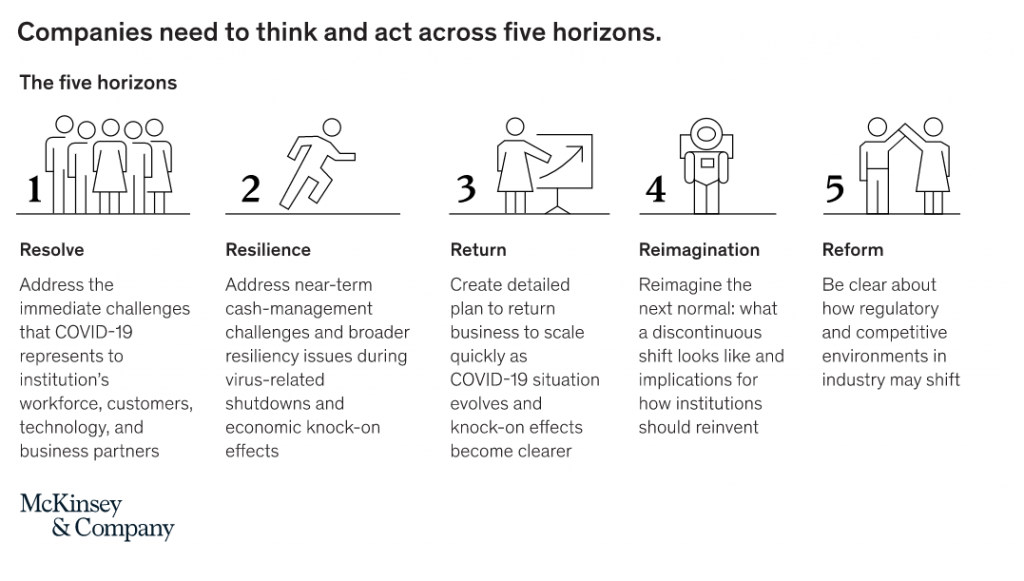
According to Mickensy article published March 2020, which talks about acting across five stages, leading from the crisis of today to the next normal that will emerge after the battle against coronavirus has been won: Resolve, Resilience, Return, Reimagination, and Reform
Resources:
- Why the corona-crisis will accelerate corporate digital transformations
- The Biggest Business Impacts of the Coronavirus Pandemic
- Open Tech Talk Sessions on Digital Transformation:
- 64- Coronavirus Outbreak: Business continuity & IT Leaders priorities
- 63- Digital transformation expectations vs. reality
- 62- First 100 Days of Digital Transformation
- 61- How to do Digital Maturity Assessment
- 60- What is digital maturity and which digital maturity model to choose?
- 59- Where to start in organization for Digital Transformation
- 58- A leap from Information Technology to Business Technology
- 57-Architecting an operating model for digital transformation
- 56- A Digital Transformation Framework
- 54-How to make a business case of Digital Transformation
- 53- Human Resources and Digital transformation
- 52- How you will know digital transformation is achieved
- 51- Enterprise Architects for Success of Digital Transformation
- 50- Is there an end to Digital Transformation?
- 49-What is for ‘me’ in Digital Transformation? Part 2
- 48- What is for ‘me’ in Digital Transformation? Part-1
- 47-How to win at Digital Transformation
- 46- Digital Transformation – it’s all about culture
- 45- How to Overcome Digital Transformation Challenges
- 44-What are the challenges in Digital Transformation
- 43-What other Organization are doing to achieve digital transformation
- 42-How do you start a Digital Transformation
- 41-What are the benefits of Digital Transformation?
- 40-Why Digital Transformation is required?
- 39-“What is digital transformation? Learning the basics”
To share your thoughts:
- Leave a comment on the section below on this post
- You want to suggest any new topic we should cover in future Podcast
- Join us in Mastermind tribe
- Share this on Twitter, Facebook, If you enjoyed this episode and we together are learning new Technologies.
To help out this initiative:
- Leave a candid review for the OTechTalks Podcast on iTunes! Your ratings and reviews will help the session on iTunes.
- Subscribe to the Podcast on iTunes to get next sessions
This intense, tragic, messy, and stormy period of the Corona Virus outbreak will eventually pass from our world and I believe we will come back to normal life.
My heart aches for the sick and scared, during this time of global crisis and I can feel for everyone how they must be going through this time. Everyone is in my prayers, which have become deeper and louder than ever before. We all need to pray for our front-line workers, primarily for health care personals and security forces how they are spending their days & nights to save all of us. This is a hard time for the entire world and I will just say, stay at home and don’t take this lightly as I see during conversations with different friends, number of people still see it as very light and they just ignore the directions of local authorities.
Don’t do this…. #stayhome.
Today we will discuss some of the points on:
- What Type of Crisis Management Team is required?
- Business continuity management priorities
- IT leaders/CIOs priorities
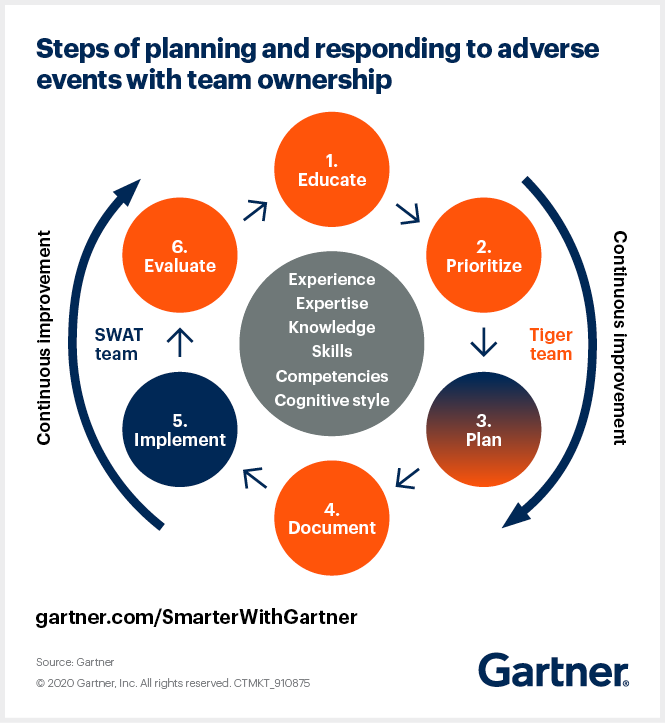
Tiger teams and SWAT teams of talented individuals selected from across your organization and focused on a specific business mission.
Tiger Teams are highly skilled, hand-picked groups of people who are tenacious about problem-solving. While the term originated at NASA, and the most famous instance is the Apollo 13 Tiger Team, the term is now generally applied to a high-functioning team of specialists who come together to complete a specific project.
As per Wikipedia “A 1964 paper entitled Program Management in Design and Development used the term tiger teams and defined it as “a team of undomesticated and uninhibited technical specialists, selected for their experience, energy, and imagination, and assigned to track down relentlessly every possible source of failure in a spacecraft subsystem or simulation”
And as per Wikipedia, on SWAT TEAM, “A SWAT team is a group of highly trained police officers who deal with very dangerous criminals. SWAT is an acronym that means Special Weapons And Tactics”
In business context, Gartner is defining as per below diagram:
We will also discuss few points on widely use Business continuity management (BCM) practices for identifying an organization’s risk of exposure to internal and external threats and how it becomes very important during the Corona Virus outbreak.
Resources:
- Create the Right Type of Crisis Management Team
- Pandemic Preparedness Requires Strong Business Continuity Management
- Open Tech Talk Sessions on Digital Transformation:
- 63- Digital transformation expectations vs. reality
- 62- First 100 Days of Digital Transformation
- 61- How to do Digital Maturity Assessment
- 60- What is digital maturity and which digital maturity model to choose?
- 59- Where to start in organization for Digital Transformation
- 58- A leap from Information Technology to Business Technology
- 57-Architecting an operating model for digital transformation
- 56- A Digital Transformation Framework
- 54-How to make a business case of Digital Transformation
- 53- Human Resources and Digital transformation
- 52- How you will know digital transformation is achieved
- 51- Enterprise Architects for Success of Digital Transformation
- 50- Is there an end to Digital Transformation?
- 49-What is for ‘me’ in Digital Transformation? Part 2
- 48- What is for ‘me’ in Digital Transformation? Part-1
- 47-How to win at Digital Transformation
- 46- Digital Transformation – it’s all about culture
- 45- How to Overcome Digital Transformation Challenges
- 44-What are the challenges in Digital Transformation
- 43-What other Organization are doing to achieve digital transformation
- 42-How do you start a Digital Transformation
- 41-What are the benefits of Digital Transformation?
- 40-Why Digital Transformation is required?
- 39-“What is digital transformation? Learning the basics”
To share your thoughts:
- Leave a comment on the section below on this post
- You want to suggest any new topic we should cover in future Podcast
- Join us in Mastermind tribe
- Share this on Twitter, Facebook, If you enjoyed this episode and we together are learning new Technologies.
To help out this initiative:
- Leave a candid review for the OTechTalks Podcast on iTunes! Your ratings and reviews will help the session on iTunes.
- Subscribe to the Podcast on iTunes to get next sessions
Digital transformation opens up a gap between the expectations created by your digital vision and the physical reality of what can be delivered to the people that keep your business alive; customers, shareholders, employees, and other stakeholders.
The gap between expectations and actual benefits of business transformation is different from organizations’ past experiences with transformation. The technologies are very disruptive.
Before diving into our today’s topic, I wanted to take a moment to acknowledge the feelings around the global COVID-19 or Corona Virus. To acknowledge our shared truth: It’s a stressful time. There’s uncertainty. There’s loss. There’s fear about the future. Let’s all focus on our families, our friends, our neighbors, and our communities. And follow to keep social distance as per WHO guidelines and work on social-learning through the remote tools available with us, remote meetup, events, virtual learning, etc.
There is a famous quote: “If you want something new, you have to stop doing something old.”
You’ll Learn:
Digital Transformation
- Digital transformation expectations vs. reality?
- How as a brand will be managing the expectations of customers from this global Covid-19
- Few Rules Will Help You Work More Productively at Home
Resources:
- Open Tech Talk Sessions on Digital Transformation:
- 62- First 100 Days of Digital Transformation
- 61- How to do Digital Maturity Assessment
- 60- What is digital maturity and which digital maturity model to choose?
- 59- Where to start in organization for Digital Transformation
- 58- A leap from Information Technology to Business Technology
- 57-Architecting an operating model for digital transformation
- 56- A Digital Transformation Framework
- 54-How to make a business case of Digital Transformation
- 53- Human Resources and Digital transformation
- 52- How you will know digital transformation is achieved
- 51- Enterprise Architects for Success of Digital Transformation
- 50- Is there an end to Digital Transformation?
- 49-What is for ‘me’ in Digital Transformation? Part 2
- 48- What is for ‘me’ in Digital Transformation? Part-1
- 47-How to win at Digital Transformation
- 46- Digital Transformation – it’s all about culture
- 45- How to Overcome Digital Transformation Challenges
- 44-What are the challenges in Digital Transformation
- 43-What other Organization are doing to achieve digital transformation
- 42-How do you start a Digital Transformation
- 41-What are the benefits of Digital Transformation?
- 40-Why Digital Transformation is required?
- 39-“What is digital transformation? Learning the basics”
- WHO – Coronavirus disease (COVID-19) outbreak
- Unlocking success in digital transformation
- Researchers from Accenture on article published in HBR on The Two Big Reasons That Digital Transformations Fail
- Another article publishes on CNBC titles: The $900 billion reason GE, Ford and P&G failed at digital transformation
- World Economic Forum and Accenture
- 2019 Global Digital Transformation Benefits Report by Schneider Electric
- Companies that earn $1 billion a year earn an additional $700 million over three years by investing in customer experience.
- 56% of CEOs say digital improvements have led to increased revenue.
- Digitally mature companies are 23% more profitable than their less mature peers.
- More than 50% of digital transformation efforts fizzled completely in 2018.
- 39% of outperforming companies have a fully integrated digital-physical strategy.
- Digital-first companies are 64% more likely to achieve their business goals than their peers
- 70% of companies either have a digital transformation strategy in place or are working on one.
- 21% of companies think they’ve already completed digital transformation.
- 40% of all technology spending in 2019 will go towards digital transformation.
- Companies will spend a total of more than $2 trillion on digital transformation in 2019.
- Most digital transformations are driven by growth opportunities, followed by increased competitive pressure and new regulatory standards.
- Executives say the top benefits of digital transformation are improved operational efficiency (40%), faster time to market (36%) and the ability to meet customer expectations (35%).
- 60% of companies that have undergone a digital transformation have created new business models.
- Just 19% of companies have a customer experience team that helps bridge gaps in the business.
- Fewer than 30% of a company’s technology vendors are actively involved in their digital transformations.
- Of the $1.3 trillion spent on digital transformation in 2018, an estimated $900 billion was wasted when initiatives didn’t meet their goals.
- 70% of digital transformations fail, most often due to resistance from employees.
- Digital transformation and a focus on customer experience can generate a 20-30% increase in customer satisfaction and economic gains of 20-50%.
- Only 16% of employees in one survey said their company’s digital transformations have improved performance and are sustainable long term.
To share your thoughts:
- Leave a comment on the section below on this post
- You want to suggest any new topic we should cover in future Podcast
- Join us in Mastermind tribe
- Share this on Twitter, Facebook, If you enjoyed this episode and we together are learning new Technologies.
To help out this initiative:
- Leave a candid review for the OTechTalks Podcast on iTunes! Your ratings and reviews will help the session on iTunes.
- Subscribe to the Podcast on iTunes to get next sessions