In today’s rapidly evolving technological landscape, the term “AI Frontier” is more than just a buzzword; it represents the uncharted territories of innovation and possibilities that AI promises. As organizations worldwide stand on the cusp of integrating AI into their core operations, the quest for knowledge on navigating this frontier becomes paramount not only for the organizations but for an individual how to navigate and start taking action to learn and grow.
Our guest today has ventured into this frontier and laid down markers, guiding others through his profound insights and groundbreaking work. As we dive deeper into today’s discussion, you will be privy to a firsthand account of the challenges and triumphs at the forefront of AI development. From understanding the nuances of AI integration to decoding its vast potential across sectors, our thought leader will shed light on the intricacies that organizations grapple with. How do businesses discern hype from genuine AI opportunities? What does it take to transform an AI concept into a tangible asset? These questions, and many more, will be unraveled as we journey through the AI frontier together, guided by the insights of a true industry pioneer.
Today’s Guest:
Manuj Aggarwal, Founder, TetraNoodle
A global thought leader who has been in AI for 15 years and has 4 patents in AI, he has served clients like Microsoft, IBM, Pearson Education, and more, producing $500 million in value for them.
- What is the biggest problem in business, and how to identify them and then look into AI to solve it?
- What is the readiness of AI for an organization, and how you can identify it
- Is AI going to take over our jobs?
- Website: TetraNoodle
- Twitter/X: Manuj Aggarwal
Resources:
To share your thoughts:
- Leave a comment in the section below on this post
- Do you want to suggest any new topic I should cover in future Podcast
- Join us in the Mastermind tribe
- Share this on Twitter and Facebook; if you enjoyed this episode, we are learning new technologies together.
To help out this initiative:
- Leave a candid review for the OTechTalks Podcast on iTunes! Your ratings and reviews will help the session on iTunes.
- Subscribe to the Podcast on iTunes to get the subsequent sessions.
Understanding AI for business and how to develop AI strategy for your organization is vital for everyone. Navigating the complex world of AI for business can be a daunting task, and with so much hype, it is now a daunting task for everyone.
However, understanding the Artificial Intelligence potential and integrating it into your organization’s strategy can unlock new opportunities for growth and efficiency. In this podcast, you will get some of the very simplified areas for you to help you how to develop an AI strategy for your business.
Before anything else, it’s crucial to have a solid understanding of what AI is, its capabilities, and how it can be utilized in various industry contexts. AI isn’t just a buzzword—it’s a tool that can automate tasks, provide insights, and even help you make more informed business decisions. Then you need to focus on what you aim to achieve with AI. Whether it’s improving customer service, increasing efficiency, or gaining a competitive edge, having clear objectives will guide your AI strategy rather than just going to adopt AI for the sake of AI.
Today’s Guest:
Kavita Ganesan is an AI advisor, strategist, educator, and founder of Opinosis Analytics.
Kavita has a Ph.D. from the University of Illinois at Urbana Champaign, specializing in NLP, Search Technologies, and Machine Learning, and she also wrote a book ‘The business case for AI’.
- How to identify use cases where AI can help the organization and the steps to follow to build the AI strategy.
- Why is it important to look at your current processes, technologies, and data infrastructure? Are they AI-ready? This assessment will help you understand where you stand and what needs to be done to integrate AI into your operations.
- If you are new to AI, how will you use it in the organization?
- Website: Opinosis Analytics
- Blog: Kavita Ganesan, PhD
- Book: The Business Case for AI
Resources:
]]>
Wondering if your business is ready for the AI revolution and if you are already aligned with AI strategy? You are not going to join the race of AI/ML just for the sake of AI/ML. These are the common questions that come to nowadays in everyone’s mind that I need to get on the bus of AI/ML, and my organization or the business should not be left behind. Whereas some fundamentals need to be looked into before embarking on this journey, and in this open talk with the guest, we tried to find some questions and answers that can help you.
We need to start with the basics. First, ask yourself if data drive your business goals. Do you have a robust data infrastructure? Can you readily access and analyze relevant and high-quality data? Are you able to act on the insights this data provides? If you nodded, you’re already on the path to becoming AI-ready!
Now, let’s discuss aligning AI and data analytics with your business goals. Maybe you want to drive up sales, streamline operations, or deliver a better customer experience. Your roadmap is data analytics – it will guide you on the best route to reach your destination. Remember, AI isn’t a magic wand but a handy tool in your toolbox. Used wisely, it can power up your business journey.
Today’s Guest:
Frank Mendoza, Founder, Catalytics Consulting
Frank will share his journey of moving from working full-time at Dell to starting his consulting firm, focusing on helping customers get results from the data. He addresses the most common misconceptions about AI and data analytics and how you handle them.
- How to create a foundation for getting long-term value rather than just focusing on adopting AI/ML
- Why is it important to focus on the objective of solving the problem and then pursue to have AI/ML implementation
- How to drive use cases for ChatGPT
- If you are new to AI and how will you start learning
- Website: Catalytics Consulting
- Linkedin: FrankMendoza
Resources:
To share your thoughts:
- Leave a comment in the section below on this post
- Do you want to suggest any new topic I should cover in future Podcast
- Join us in the Mastermind tribe
- Share this on Twitter and Facebook; if you enjoyed this episode, we are learning new technologies together.
To help out this initiative:
- Leave a candid review for the OTechTalks Podcast on iTunes! Your ratings and reviews will help the session on iTunes.
- Subscribe to the Podcast on iTunes to get the subsequent sessions.
The final dissertation project as part of the MSc Artificial Intelligence program started in September 2022, this is the third month, and I thought to start sharing publically.
The major topic of my research is the healthcare sector, specifically maternal, specifically Maternal & Infant Health. I have created a details project proposal and submitted it to the university.
Here you will get the technical aspects of the work I am doing to complete my research, as it involves artificial intelligence and Machine learning on a huge dataset. I am into an interesting challenge, which almost daily enables me to learn something new.
Today onward, I will update here the progress and will also try to update the key aspects of the last 3 months work. let’s get started
A few tweets will give you a glimpse of the work over the last few weeks.
November 23, 2022: It began with the writing of this blog based on the difficulties of “preprocessing” datasets, I decided to revisit the CSV files and shorten the columns to the required only columns. Earlier, I did all this work after uploading it to the autonomous database.
Challenge: CSV file has approximately 3.6 million records, and MS excel can only support 1,048,576 rows. found some ideas to split it, and here is the method I have used to split the CSV file into multiple files and then work on it.
moved it into the desired folder, where my dataset files are available, and used the terminal window to execute the below command.
split -l 1000000 2021natdata.csvThis has created the files based on the data, so I have 4 files with naming conventions like xaa, xab, xac, xad.
now, these files need to be converted to CSV format, so I have used this statement, and all this found on google research.
for i in *;
do mv "$i" "$i.csv";
done
It gives me all four files in CSV format, and I have to do it for all my source dataset files.
How to convert large CSV files into multiple files.
Nov 24, 2022: Today’s task was to update the column name to some meaningful name so that it is easy to understand while just reading the column’s name.
for example, column name ‘dmar’ to ‘MaritalStatus’ and ‘rf_cesar’ to ‘PreviousCesarean’
It was pretty challenging with the 16 different CSV files, and the average records were 1 million in each CSV file.
Loaded all CSVs data into Oracle Autonomous Datawarehouse in less than 30 minutes
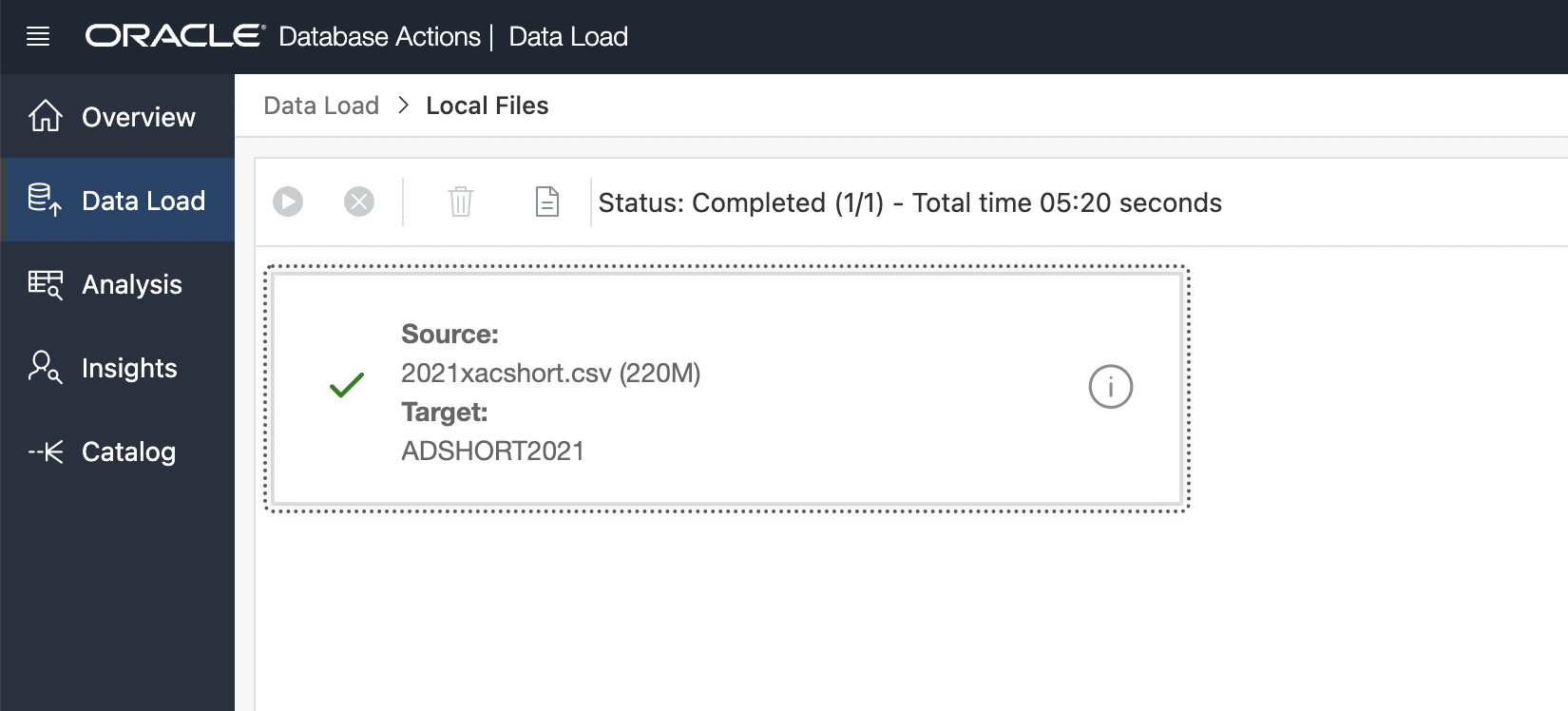
I spent my weekend to debug this error while getting ready my dataset for data science project
— Kashif Manzoor (@kashifmanzoor) October 30, 2022
Finally, reached to a expert friend and it got solved in few minutes
10 hours spent on debugging help me to learnpic.twitter.com/2C7eWlo67L
15-March-2023
first of all my apology for not being able to update this, as the initial idea was to document the journey.
However with the extensive work required me to do for this dissertation, I was not able to cope with the pace and was not able to update this post.
I submitted my dissertation during the first week of March, and from now onward I will try to write separate blogs to help others to pursue their career dreams.
]]>They will help you build the
- Practical skills to solve problems
- Make strategic decisions.
- Eventually, lead your organization’s AI transformation journey
Machine Learning: Practical Applications
Module 1: Learning from data
Module 2: Principles of machine learning
Module 3: Regression
Module 4: Variable selection and shrinkage methods
Artificial Intelligence: Implications for Business Strategy
Module 1: An introduction to artificial intelligence
Module 2: Machine learning in business
Module 3: Natural language processing in business
Module 4: Robotics in business
Oxford Artificial Intelligence Programme
Module 1: Artificial intelligence ecosystem
Module 2: AI and machine learning: Understanding the black box
Module 3: Understanding deep learning and neural networks
Module 4: Working with intelligent machines
Module 5: The ethics of artificial intelligence
Artificial Intelligence in Health Care
Module 1: AI and machine learning — applications and foundations
Module 2: Using AI for disease diagnosis and patient monitoring
Module 3: Natural language processing and data analytics in health care
Module 4: Interpretability in machine learning — Benefits and challenges
Module 5: Patient risk stratification and augmenting clinical workflows
Module 6: Taking an integrated approach to hospital management and optimization
Artificial Intelligence in Business:
Module 1: The business case for AI
Module 2: Algorithms: Learning and problem-solving
Module 3: AI-driven use cases in industries
Module 4: AI governance and ethics
MIT Machine Learning in Business
Module 1: Introduction to machine learning
Module 2: Implementing machine learning in a business
Module 3: Sensing the physical world
Module 4: Helping machines learn to use language
Whether you consider yourself computer smart or not, there’s a strong chance artificial intelligence (AI) has already impacted the way you interact with systems, organizations, and other people. You may transform those individual experiences into useful information and career advancement through these courses
]]>
An overview of Oracle’s different Artificial Intelligence, machine learning, and data science solutions available on Oracle Cloud. If you are new to this website, it is a learning and sharing platform where we will learn publicly.
Before I cover today’s show schedule, let me admit that procrastination is sometimes very dangerous, as I could not record/host the podcast for the last 4 months. It wasn’t easy to have a work-life balance due to the two factors. First, as I am doing MSc in AI and the previous 4-5 months were crucial to complete the key subjects, now I am on the last topic of robotics, which will be completed very soon. And 2nd factor was that I was dedicating a lot of my time to office work, where I worked with several EMEA-based customers and helped them migrate on-premise workloads to the Oracle cloud.
On the procrastination, James clear’s book ‘Atomic habit’ and specifically the article “Procrastination: A Scientific Guide on How to Stop Procrastinating” has helped me to come out of the phase and be back with the podcast 
Let’s dive into today’s topic. Oracle has solutions that broadly cover three areas from the product’s point of view. We will also talk about some of the use cases along with these products.
1-Artificial intelligence services, 2- Machine learning services and 3- AI apps for SaaS services
1-Artificial intelligence services deliver pre-trained models that can also be custom trained to improve model quality and enable organizations to use the AI services.
2-Machine learning services enable organizations to build, manage and deploy machine learning models with the different open source frameworks or they can use in-database machine learning capabilities.
3-AI apps for SaaS services provide organizations with capabilities in pre-integrated and fully functional AI functionalities in the Software as a Services (SaaS) model. These services are primarily part of the Oracle Cloud Applications. It uses deep semantic parsing with natural language processing (NLP), natural language understanding (NLU), and custom algorithms to understand common conversations to derive real intent and context. In addition, users can communicate with the business application using voice commands capabilities available in the digital assistant offered by Oracle’s Voice, it is not relying on any third party offerings.
You’ll Learn:
Different offerings for AI, ML and Data Science from Oracle Cloud:
- Overview of the AI/ML & Data science services
- Oracle Digital Assistant
- Oracle Cloud Infrastructure Language
- Oracle Cloud Infrastructure Speech
- Oracle Cloud Infrastructure Vision
- Oracle Cloud Infrastructure Anomaly Detection
- Oracle Cloud Infrastructure Forecasting
- Oracle Cloud Infrastructure Data Science
- Machine Learning in Oracle Database
- Oracle Cloud Infrastructure Data Labeling
- Oracle Cloud Infrastructure Virtual Machines for Data Science
- Oracle AI Apps for Finance
- Oracle AI Apps for Human Resources
- Oracle AI Apps for Sales
- Oracle AI Apps for Service
- Oracle AI Apps for Procurement
- Common uses cases to achieve with these cloud services/solutions.
Resources:
- Procrastination: A Scientific Guide on How to Stop Procrastinating
- Artificial Intelligence (AI) from Oracle
- OCI Anomaly Detection Service is an innovative algorithm called the multivariate sampling estimation technique (MSET)
- Forecasting use cases
- 97 – What are the leading cloud migration challenges?
- 95- Cloud Security with CIS Benchmarks
- 94- How to develop a cloud migration strategy?
- 93- Cloud Migration Workload Assessment
- 91- Workload Migration to Cloud – Getting Started
To share your thoughts:
- Leave a comment in the section below on this post
- Do you want to suggest any new topic I should cover in future Podcast
- Join us in the Mastermind tribe
- Share this on Twitter, and Facebook, If you enjoyed this episode and we together are learning new technologies.
To help out this initiative:
- Leave a candid review for the OTechTalks Podcast on iTunes! Your ratings and reviews will help the session on iTunes.
- Subscribe to the Podcast on iTunes to get the next sessions
How machine learning works in the real world and how data scientists use the four necessary steps for building a machine learning application (or model). The primary building blocks of a Machine Learning system are the model, the parameters, and the learner. The model is which makes predictions; the parameters are the factors or variables & features which are considered by the model to make predictions, and the learner completes the adjustments in the parameters and the model to align the projections with the actual results.
First session to learn as a beginners to ML, go to the first post What is machine learning? learning the basics (otechtalks.tv)
MIT Course Video on Machine Learning
You’ll Learn:
It’s a beginners guide to learn the basics of the ML
- Preparing a training data set
- Selection of algorithm to run on the training data set
- Training the algorithm to create the model
- Using and improving the model
Resources:
- What is machine learning? learning the basics
- Book: Artificial intelligence, a modern approach
- Book: Foundation of ML
- How Facebook uses ML
- Basics of Machine Learning
- Deep Learning Courses
- Edx – Machine Learning
- Coursera
To share your thoughts:
- Leave a comment on the section below on this post
- You want to suggest any new topic we should cover in future Podcast
- Join us in Mastermind tribe
- Share this on Twitter, Facebook, If you enjoyed this episode and we together are learning new technologies.
To help out this initiative:
- Leave a candid review for the OTechTalks Podcast on iTunes! Your ratings and reviews will help the session on iTunes.
- Subscribe to the Podcast on iTunes to get the next sessions
Machine learning: a computer observes some data, builds a model based on the data, and uses the model as both a hypothesis about the world and a piece of software that can solve problems, According to the book ‘Artificial Intelligence, a modern approach’.
Machine learning is a division of artificial intelligence (AI) focused on computational programs that learn from experience and improve decision-making or predictive accuracy over time.
In this podcast, our focus will be to go through very basics concepts of machine learning along with the different methods of machine learning, for example, supervised learning, unsupervised learning, reinforcement learning, and Semi-supervised machine learning.
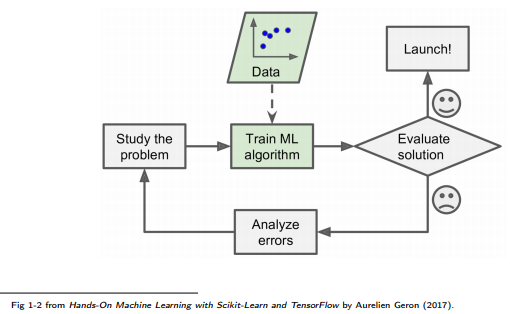
Machine learning is not a ‘Rule-Based Approach’ which was common in 1980
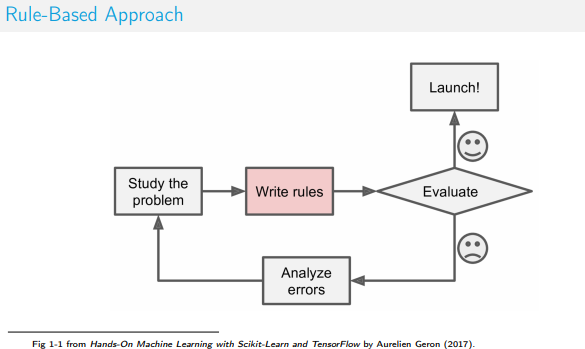
a modern machine learning approach is explained in this diagram:
You’ll Learn:
It’s a beginners guide to learn the basics of the ML
- What is machine learning?
- Machine learning methods
- Machine Learning Basic Concepts
Resources:
- How machine learning works?
- Book: Artificial intelligence, a modern approach
- Book: Foundation of ML
- Block box ML
- 14 Different Types of Learning in ML
- Deep Learning Courses
- Edx – Machine Learning
- Coursera
To share your thoughts:
- Leave a comment on the section below on this post
- You want to suggest any new topic we should cover in future Podcast
- Join us in Mastermind tribe
- Share this on Twitter, Facebook, If you enjoyed this episode and we together are learning new technologies.
To help out this initiative:
- Leave a candid review for the OTechTalks Podcast on iTunes! Your ratings and reviews will help the session on iTunes.
- Subscribe to the Podcast on iTunes to get the next sessions
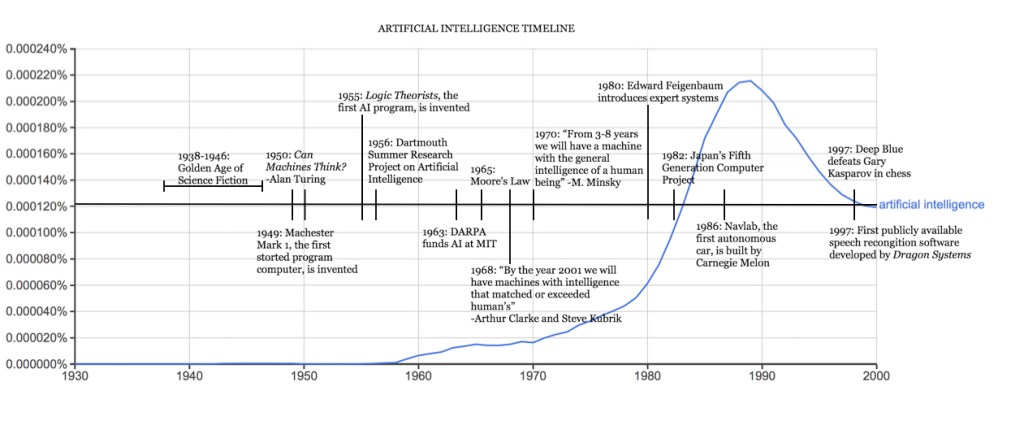
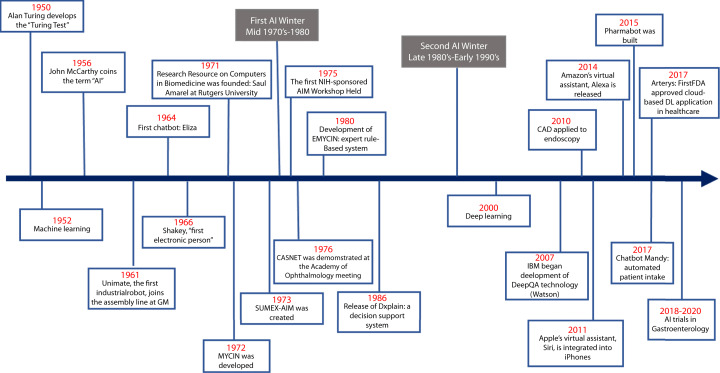
I have embarked on a journey to study Artificial Intelligence and pursue formal study as an MSc course six months back. I was amazed to read the history of artificial intelligence. It was awe-inspiring knowledge of how legends have coined ‘artificial intelligence’, thought to share with you some of the highlights. It will give you the very basics of AI. From where it started and how it was passing through from different periods.
Definition of AI
Now before will go to history, let’s understand the basic formal definition of AI. According to written at Britannica
- Artificial intelligence (AI), the ability of a digital computer or computer-controlled robot to perform tasks commonly associated with intelligent beings. The term is frequently applied to the project of developing systems endowed with the intellectual processes characteristic of humans, such as the ability to reason, discover meaning, generalize, or learn from past experience
- “Artificial intelligence is a computerized system that exhibits behavior that is commonly thought of as requiring intelligence.” Written in “Preparing for the Future of Artificial Intelligence, NSTC, 2016”
- “Artificial Intelligence is the science of making machines do things that would require intelligence if done by man.” In “6. Raphael, B. 1976. The thinking computer. San Francisco, CA: W.H. Freeman”
- “AI is the science and engineering of making intelligent machines, especially intelligent computer programs.” Source: http://www-formal.stanford.edu/jmc/whatisai/node1.html
Machine Learning (ML): pattern identification and analysis; machines can improve with experience from provided data sets
Deep Learning (DL): composed of multi-layer neural networks that enable machines to learn and make decisions on their own
According to several books, the roots of modern AI are way back. However, I will share with you when the term ‘AI’ is presented to the world and so on.
Most of the contents of this episode are taken from the book “Artificial Intelligence – A Modern Approach, fourth edition.
AI and Life in 2030 – one hundred year study on artificial intelligence
Stanford University released its first report for the One Hundred Year Study, a long-term look into the future of AI
Another good way to present from Science in the news at Harvard University
Resources:
- The Present and Future of AI by Gartner
- Strategic Framework for AI Use Cases by Industry – Gartner
- Artificial Intelligence by Stanford Encylopedia of Philosophy
- A Complete History of AI
To share your thoughts:
- Leave a comment on the section below on this post
- You want to suggest any new topic we should cover in future Podcast
- Join us in Mastermind tribe
- Share this on Twitter, Facebook, If you enjoyed this episode and we together are learning new Technologies.
To help out this initiative:
- Leave a candid review for the OTechTalks Podcast on iTunes! Your ratings and reviews will help the session on iTunes.
- Subscribe to the Podcast on iTunes to get next sessions
I like it, try out and enjoy coding with Python…
Colaboratory, or “Colab” for short, allows you to write and execute Python in your browser, with
- Zero configuration required
- Free access to GPUs
- Easy sharing
and if you want to install on your local computer to run Python code, here is the step by step process.
If you are new to the Python and want to learn the basics here is the video
Something new to know about Python, “Zen of Python” guiding principles to design the Python programming language.
Another amazing and very good video to consult for Jupyter notebooks