
In our connected world, keeping our online spaces secure is a top priority for everyone – businesses, startups, and individuals alike. Today’s episode is all about making cybersecurity simple and accessible. We’ll cover how to start protecting yourself and your organization, address the need for more skilled professionals, and examine how new technologies make security brighter. Suppose you’ve ever wondered about the best ways to stay safe online. In that case, this conversation is for you about what it takes to build a career in cybersecurity or how innovation is shaping the future of protection. Let’s dive in together and learn how to keep our digital lives safe and sound.
Before inviting the guest speaker, I will also discuss my experience attending WebSummit Qatar and some of the latest news from the Leap 2024 event in Saudi Arabia.
We all now must be aware that the consequences of neglecting cybersecurity can be dire, from personal data breaches to large-scale attacks on corporations and governments. I know we hate to keep long-digit passwords, but there is so much happening in the security world that we all need to be extra conscious and take serious steps.
Episode # 130
Today’s Guest:
Nick Lorizio, Founder, AstuteTechnologists
- Website: AstuteTechnologists
- Linkedin: NickLorizio
The insights into cybersecurity include learning how to bolster security within your organizations and personal digital spaces.
What Listeners Will Learn:
In today’s podcast, you’ll gain insights into several key areas:
- Understanding Security Necessities: Learn why individuals and organizations must prioritize cybersecurity, recognizing the unique challenges each faces and the critical importance of investment in this area for protecting data and ensuring operational continuity.
- Innovation in Security: Learn about the inspiration behind developing a security product, identifying market needs, and how innovative technologies like AI are integrated into cybersecurity solutions to enhance protection and efficiency.
- Guidance for Startups: Discover tailored advice for startups or those early in product development on embedding cybersecurity measures from the outset, ensuring a secure foundation as they scale.
- Personal Security Strategies: Gain strategies and best practices that individuals can adopt to safeguard themselves in the digital world.
- Addressing Talent Shortage: Explore the current landscape of cybersecurity talent shortage, understand its impact on the industry, and learn how to mitigate this issue through education, training, and community engagement.
- Career Growth in Cybersecurity: Receive suggestions for individuals looking to start or advance their careers in cybersecurity, including educational paths, skill development, and networking strategies.
- Foundational Insights: Hear firsthand about the biggest mistakes to avoid as a founder and the key traits to look for when building a team, providing a deeper understanding of the leadership and decision-making process in the cybersecurity sector.
Resources:
- Website: AstuteTechnologists
- Linkedin: NickLorizio
- Amjad Masad, CEO of Replit
- Groq
Managed services have become a linchpin in the strategy of companies looking to harness technology for growth, efficiency, and innovation.
We delve into the transformative world of managed services and their role in business strategy.
The shift from in-house tech management to outsourcing to specialized tech companies represents a strategic reorientation for many businesses. This critical decision allows companies to focus on their core competencies, entrusting the technological complexities to expert service providers. Yet, challenges arise, especially for tech-centric businesses that prioritize maintaining control over their IT infrastructures.
We explore this delicate balance between managing in-house technology and reaping the benefits of outsourced services.
This blog post and accompanying podcast are tailored for business leaders contemplating the shift to managed services and MSPs aiming to align their services with client success. Stay tuned as we navigate the dynamic and evolving landscape of managed services and AI applications in business.
Episode # 122
Today’s Guest:
Dave Sobel, Host of the Business of Tech podcast and owner of MSP Radio
- Website: Business of Tech
- Youtube: MSP Radio
- Twitter: MSPRadio
What Listeners Will Learn:
In today’s podcast, you’ll gain insights into several key areas:
- Choosing the Right MSP: We discuss how selecting a managed services provider (MSP) goes beyond technical capabilities and involves making a strategic business decision.
- Acquiring the Right Talent: Tackling the crucial question of talent acquisition from outsourced providers, we weigh the pros and cons of direct involvement in the selection process versus trusting the expertise of MSPs.
- Meeting Business Expectations: How are companies’ expectations of MSPs being met, and what improvements can be made to these partnerships?
- Evolving Landscape of Managed Services: Examining current trends in the managed services sector to understand whether their prevalence is increasing and how this impacts business strategies.
- The Role of MSPs in Client Success: Delving into how MSPs can ensure their clients achieve success and support them in their business journey.
- AI in Business: Understanding the application of AI, especially Generative AI, in business, its strengths, limitations, and scenarios where it may not be the ideal solution.
Resources:
]]>
The final dissertation project as part of the MSc Artificial Intelligence program started in September 2022, this is the third month, and I thought to start sharing publically.
The major topic of my research is the healthcare sector, specifically maternal, specifically Maternal & Infant Health. I have created a details project proposal and submitted it to the university.
Here you will get the technical aspects of the work I am doing to complete my research, as it involves artificial intelligence and Machine learning on a huge dataset. I am into an interesting challenge, which almost daily enables me to learn something new.
Today onward, I will update here the progress and will also try to update the key aspects of the last 3 months work. let’s get started
A few tweets will give you a glimpse of the work over the last few weeks.
November 23, 2022: It began with the writing of this blog based on the difficulties of “preprocessing” datasets, I decided to revisit the CSV files and shorten the columns to the required only columns. Earlier, I did all this work after uploading it to the autonomous database.
Challenge: CSV file has approximately 3.6 million records, and MS excel can only support 1,048,576 rows. found some ideas to split it, and here is the method I have used to split the CSV file into multiple files and then work on it.
moved it into the desired folder, where my dataset files are available, and used the terminal window to execute the below command.
split -l 1000000 2021natdata.csvThis has created the files based on the data, so I have 4 files with naming conventions like xaa, xab, xac, xad.
now, these files need to be converted to CSV format, so I have used this statement, and all this found on google research.
for i in *;
do mv "$i" "$i.csv";
done
It gives me all four files in CSV format, and I have to do it for all my source dataset files.
How to convert large CSV files into multiple files.
Nov 24, 2022: Today’s task was to update the column name to some meaningful name so that it is easy to understand while just reading the column’s name.
for example, column name ‘dmar’ to ‘MaritalStatus’ and ‘rf_cesar’ to ‘PreviousCesarean’
It was pretty challenging with the 16 different CSV files, and the average records were 1 million in each CSV file.
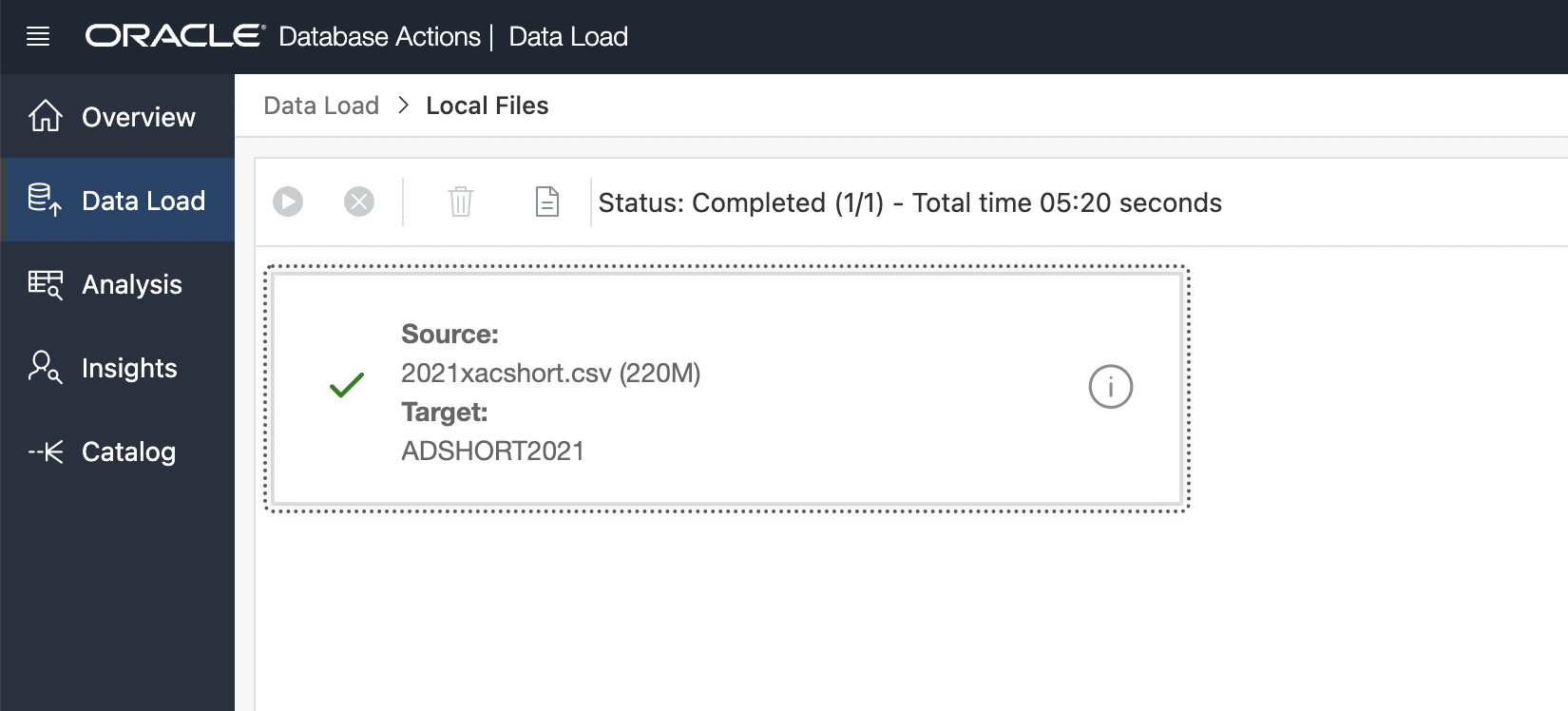
Loaded all CSVs data into Oracle Autonomous Datawarehouse in less than 30 minutes
I spent my weekend to debug this error while getting ready my dataset for data science project
— Kashif Manzoor (@kashifmanzoor) October 30, 2022
Finally, reached to a expert friend and it got solved in few minutes
10 hours spent on debugging help me to learnpic.twitter.com/2C7eWlo67L
15-March-2023
first of all my apology for not being able to update this, as the initial idea was to document the journey.
However with the extensive work required me to do for this dissertation, I was not able to cope with the pace and was not able to update this post.
I submitted my dissertation during the first week of March, and from now onward I will try to write separate blogs to help others to pursue their career dreams.
]]>
Every day, we are reading reports on cyberattacks and massive data breaches worldwide, resulting in substantial financial losses, disruption, and downtime. The most important thing to notice is that every day cybercriminals adopt new attacks to avoid traditional security measures and bring new approaches to achieve the target. There is a concept of having layered security, with this approach of layered security enables you to have a system for an Internet security strategy that ensures an attacker who tries to penetrate one layer of defence will be stopped by a subsequent layer. Let’s get first the definition clear about layered security.
What is Layered Security?
According to, Techopedia, the layered security is:
“Layered security refers to security systems that use multiple components to protect operations on multiple levels or layers. This term can also be related to the term defence-in-depth, which is based on a slightly different idea where multiple strategies and resources are used to slow, blog, delay, or hinder a threat until it can be completely neutralized”
National Institute of Standards and Technology (NIST) Guidance, NIST has defined a layered security model that has 17 control families
This session was recorded back in October 2021, and it is now being published.
Today’s Guest
Greg Edwards, CEO at CryptoStopper
An inspirational talk with the guest speaker on a topic, a SaaS product targeted to help detect and stop ransomware.
- Why it is important to focus on security and have a Layered security approach for your organization.
- As a CEO the favourite tool is being used every day for SaaS product development.
- What are the qualifies required to get hired from a CEO perspective and many more such insights you will have
- Website: CryptoStopper
- Twitter: CryptoStopper
Resources:
- CryptoStopper
- Techopedia, the layered security
- National Institute of Standards and Technology (NIST) Guidance NIST has defined a layered security model that has 17 control families

An overview of Oracle’s different Artificial Intelligence, machine learning, and data science solutions available on Oracle Cloud. If you are new to this website, it is a learning and sharing platform where we will learn publicly.
Before I cover today’s show schedule, let me admit that procrastination is sometimes very dangerous, as I could not record/host the podcast for the last 4 months. It wasn’t easy to have a work-life balance due to the two factors. First, as I am doing MSc in AI and the previous 4-5 months were crucial to complete the key subjects, now I am on the last topic of robotics, which will be completed very soon. And 2nd factor was that I was dedicating a lot of my time to office work, where I worked with several EMEA-based customers and helped them migrate on-premise workloads to the Oracle cloud.
On the procrastination, James clear’s book ‘Atomic habit’ and specifically the article “Procrastination: A Scientific Guide on How to Stop Procrastinating” has helped me to come out of the phase and be back with the podcast 
Let’s dive into today’s topic. Oracle has solutions that broadly cover three areas from the product’s point of view. We will also talk about some of the use cases along with these products.
1-Artificial intelligence services, 2- Machine learning services and 3- AI apps for SaaS services
1-Artificial intelligence services deliver pre-trained models that can also be custom trained to improve model quality and enable organizations to use the AI services.
2-Machine learning services enable organizations to build, manage and deploy machine learning models with the different open source frameworks or they can use in-database machine learning capabilities.
3-AI apps for SaaS services provide organizations with capabilities in pre-integrated and fully functional AI functionalities in the Software as a Services (SaaS) model. These services are primarily part of the Oracle Cloud Applications. It uses deep semantic parsing with natural language processing (NLP), natural language understanding (NLU), and custom algorithms to understand common conversations to derive real intent and context. In addition, users can communicate with the business application using voice commands capabilities available in the digital assistant offered by Oracle’s Voice, it is not relying on any third party offerings.
You’ll Learn:
Different offerings for AI, ML and Data Science from Oracle Cloud:
- Overview of the AI/ML & Data science services
- Oracle Digital Assistant
- Oracle Cloud Infrastructure Language
- Oracle Cloud Infrastructure Speech
- Oracle Cloud Infrastructure Vision
- Oracle Cloud Infrastructure Anomaly Detection
- Oracle Cloud Infrastructure Forecasting
- Oracle Cloud Infrastructure Data Science
- Machine Learning in Oracle Database
- Oracle Cloud Infrastructure Data Labeling
- Oracle Cloud Infrastructure Virtual Machines for Data Science
- Oracle AI Apps for Finance
- Oracle AI Apps for Human Resources
- Oracle AI Apps for Sales
- Oracle AI Apps for Service
- Oracle AI Apps for Procurement
- Common uses cases to achieve with these cloud services/solutions.
Resources:
- Procrastination: A Scientific Guide on How to Stop Procrastinating
- Artificial Intelligence (AI) from Oracle
- OCI Anomaly Detection Service is an innovative algorithm called the multivariate sampling estimation technique (MSET)
- Forecasting use cases
- 97 – What are the leading cloud migration challenges?
- 95- Cloud Security with CIS Benchmarks
- 94- How to develop a cloud migration strategy?
- 93- Cloud Migration Workload Assessment
- 91- Workload Migration to Cloud – Getting Started
To share your thoughts:
- Leave a comment in the section below on this post
- Do you want to suggest any new topic I should cover in future Podcast
- Join us in the Mastermind tribe
- Share this on Twitter, and Facebook, If you enjoyed this episode and we together are learning new technologies.
To help out this initiative:
- Leave a candid review for the OTechTalks Podcast on iTunes! Your ratings and reviews will help the session on iTunes.
- Subscribe to the Podcast on iTunes to get the next sessions
The cloud adoption framework of several cloud vendors helps cloud architects, IT professionals, and decision-makers have a set of protocols, best practices, and tools for the journey to the cloud. Each cloud vendor has divided the adoption framework into different phases, and in this session, I will walk you through the high-level stages of each cloud adoption framework.
The first session on this topic is covered in session number 99 with the title “Cloud Adoption Framework“. In this session, I will cover the Cloud Adoption framework of Oracle, Google Cloud, AWS, IBM Cloud, and Alibaba Cloud.
You’ll Learn:
Different Cloud Adoption Frameworks:
- Different Phases of Cloud Adoption Framework of different Cloud Vendors?
- Part I – Learn about what is Cloud Adoption framework and what are the common frameworks
Resources:
- 99 – Cloud Adoption Framework
- Oracle Cloud Adoption Framework
- AWS CAP
- Microsoft Azure CAP
- IBM Cloud Cloud Adoption
- Google Cloud Adoption Framework
- Alibaba Cloud Migration Methodology
- Open Data Center Alliance Cloud Adoption Framework
- Unified Cloud Computing Adoption Framework during IEEE 2017 international conference on information systems and computer science
- Enterprise Cloud Adoption Framework developed and shared by the MITRE
- 97 – What are the leading cloud migration challenges?
- 95- Cloud Security with CIS Benchmarks
- 94- How to develop a cloud migration strategy?
- 93- Cloud Migration Workload Assessment
- 91- Workload Migration to Cloud – Getting Started
To share your thoughts:
- Leave a comment on the section below on this post
- You want to suggest any new topic we should cover in future Podcast
- Join us in the Mastermind tribe
- Share this on Twitter, Facebook, If you enjoyed this episode and we together are learning new technologies.
To help out this initiative:
- Leave a candid review for the OTechTalks Podcast on iTunes! Your ratings and reviews will help the session on iTunes.
- Subscribe to the Podcast on iTunes to get the next sessions
Cloud Adoption Framework is a set of best practices, tools, and guides that most public cloud vendors publish. The idea behind these cloud adoption frameworks is to assist organizations to embrace public cloud securely, efficiently and faster. The cloud adoption framework comprises each phase of cloud acceptance, from planning to living in the cloud. It provides a very well-tested checklist and steps to choose the right path for cloud migration and the right tools to help reduce potential security, governance, and budget problems.
The good thing about the cloud adoption framework is that it covers technological, people, processes and business aspects. Therefore, it helps to align business strategies with the culture, business and technology inspirations to achieve the business benefits.
Cloud growth
The cloud adoption framework is your guide to making the most of your cloud investment. Most organizations are adopting the cloud as per the IDG’s 2020 Cloud Computing study reveals that 92% of the organizations are somewhat in the cloud.
Organizations must adapt to the cloud with proper planning and strategy in place. However, I observe that even if they have the strategy, they have just started consuming the cloud with the migration of simple applications and don’t have any proper framework or rules to follow. Another challenge I am seeing is that organizations don’t have clear visibility to their digital estate. When you start planning about cloud migration or adoption, the first question that comes to mind is to discover or assess the current IT state, which sometimes becomes painful to complete. Sometimes, what is being observed is that relevant stakeholders don’t know where to start and the requirements or initial checklist they need to follow to migrate to the cloud.
According to Gartner, if we map to the trends impacting cloud adoption, there are four critical areas.
- Cost optimization will drive cloud adoption
- Multicloud will reduce vendor lock-in
- Insufficient cloud IaaS skills will delay migrations
- Distributed cloud will support expanded service availability
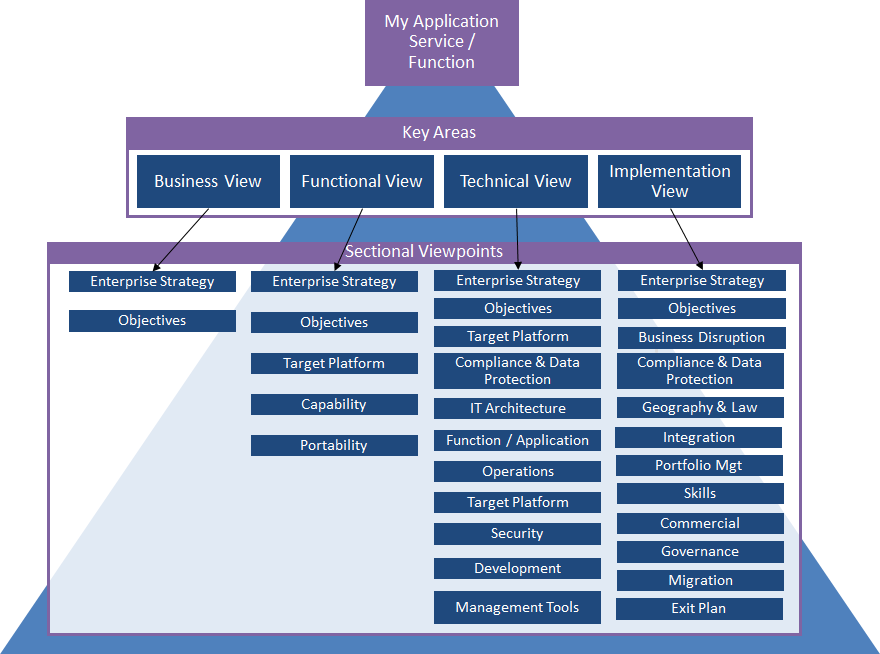
There is no doubt that each organization is unique with the operating model, products, services, organizational infrastructure and technology. Now adopting the cloud also depends on the business functions, services and applications are used in the organization; it will be unique to every organization. However, as we are seeing, most organizations are moving to the cloud, so we can say there is a pattern emerging. These frameworks are the results of these patterns concluded from a large number of cloud migrations journeys. Take an example of the work done by the Open Data Center Alliance Cloud Adoption Framework
Another paper was presented during the 2017 international conference on information systems and computer science with the name “Unified Cloud Computing Adoption Framework.” which describes the process in six steps framework, current situation definition, requirements definition, providers analysis, providers assessment, decision, and migration.
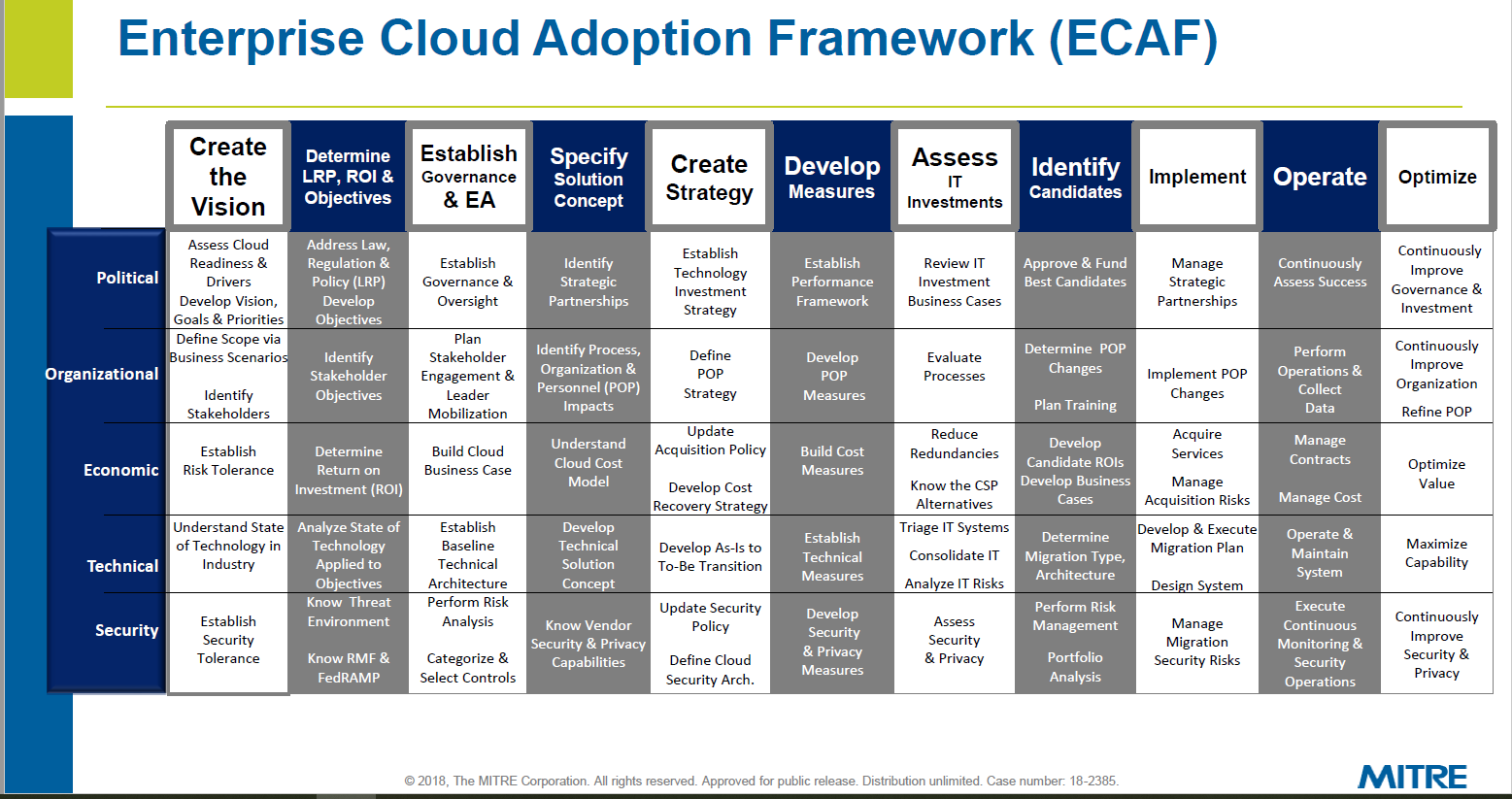
Another interesting and the most I like Enterprise Cloud Adoption Framework developed and shared by the MITRE and targeted areas to address are Political leadership, Organizational, Economic, Technical and Security (POETS) factors.
You’ll Learn:
Different Cloud Adoption Frameworks:
- What is ECAF?
- What are the common Cloud Adoption frameworks?
- Why frameworks are important for journey to cloud?
- How different cloud vendors are treating these frameworks?
- Part II – To Learn more about the different Cloud Vendors adoption framework
Resources:
- 100 – Cloud Adoption Framework from Different Cloud Vendors- Part II
- IDG’s 2020 Cloud Computing study
- Gartner, 4 trends impacting cloud adoption
- Open Data Center Alliance Cloud Adoption Framework
- Unified Cloud Computing Adoption Framework during IEEE 2017 international conference on information systems and computer science
- Enterprise Cloud Adoption Framework developed and shared by the MITRE
- 97 – What are the leading cloud migration challenges?
- 95- Cloud Security with CIS Benchmarks
- 94- How to develop a cloud migration strategy?
- 93- Cloud Migration Workload Assessment
- 91- Workload Migration to Cloud – Getting Started
To share your thoughts:
- Leave a comment on the section below on this post
- You want to suggest any new topic we should cover in future Podcast
- Join us in the Mastermind tribe
- Share this on Twitter, Facebook, If you enjoyed this episode and we together are learning new technologies.
To help out this initiative:
- Leave a candid review for the OTechTalks Podcast on iTunes! Your ratings and reviews will help the session on iTunes.
- Subscribe to the Podcast on iTunes to get the next sessions
Cloud migration is challenging, cumbersome, and risky for traditional organizations relying on in-house custom-built systems to support achieving revenue from years on years. Today I will be discussing a wide variety of challenges organizations are facing while planning for cloud migration. These typical challenges are talks of every board room and the agenda of the meetings. However, there is no doubt that workloads migration to the cloud is helping organizations to reduce operating costs and build integrated, automated IT infrastructure.
Some Facts on Public Cloud:
- The global public cloud computing market is continuing to grow, and according to the Statista report of August 4, 2021, it will $482 billion in 2022.
- IDG’s 2020 Cloud Computing study reveals that 92% of the organizations are somewhat in the cloud.
- According to the worldwide enterprise cloud strategy 2017-2020 report by Statista, 82% of the respondent reported that they had deployed hybrid cloud strategy in their organizations.
- Gartner’s global forecast for public cloud end-user spending will grow 23.1% in 2021 to reach $332.3 billion, compares to $270 billion in 2020. (read diagram/table for podcast)
- Canalys report for the year 2020 that “total cloud infrastructure services spending grew 33% to US$142 billion, up from US$107 billion in 2019.”
- IDC’s report on global public cloud services $312 Billion in 2020
- Cloud computing market report published by marketsandmarkets “The global cloud computing market size is expected to grow from USD 371.4 billion in 2020 to USD 832.1 billion by 2025”
- Share of corporate data stored in the cloud in organizations worldwide from 2015 to 2021 “As of 2021, around 50 percent of all corporate data is stored in the cloud. This share reached 30 percent in 2015 and has continued to grow as companies increasingly shift their resources into cloud environments in the hope of improving security and reliability next to advancing business agility.“
How to Secure and optimize your cloud migration
You have a daunting task in hand to migrate to the cloud and do it securely and efficiently. If it is not fully optimized and performed correctly, your dream of digital transformation in an organization can hit roadblocks/pitfalls.
Now I will share some of the common challenges which I see the cloud migrations; these are based on observation, reading a wide array of articles, and discussion with fellow IT friends/colleagues in the extended & broader community of IT professionals. What I will be doing is to mention all the typical challenges, and then I will also try to share the perspective of how you can overcome or what could be the strategy to address them. These could be starting from which workloads to be moved to what should be the order of migration to how we will have reliability and performance of business-critical services on the cloud. How I will implement required levels of security controls and regulatory compliance to who is my cloud vendor and this cloud migration must not disrupt my existing IT services, so on…

Gartner, in an article published, has beautifully categorized into six ways of cloud migrations challenge
You’ll Learn:
Common Cloud Migration Challenges and How to Overcome Them:
- Why cloud migration is challenging?
- Some facts on public cloud adoption
- Common Challenges:
- Do you have a well-defined & documented Cloud Migration Strategy?
- How do you see your requirements for Data Security and Compliance?
- Do you have clarity on the Cost of the Cloud Migration Process?
- How is your organization’s response to adoption/change?
- Migrating to cloud – is it Vendor Lock-In? and Who is the best Cloud Service Provider for me?
- Have you done a proper evaluation of the current IT portfolio (workload migration assessment)
- How to ensure minimum business downtime/minimum business disruption
Resources:
- Cloud Computing Trends: 2021 State of the Cloud Report
- Statista report of August 4, 2021, it will $482 billion in 2022.
- IDG’s 2020 Cloud Computing study
- worldwide enterprise cloud strategy 2017-2020 report by Statista
- Gartner’s global forecast for public cloud end-user spending
- Canalys report for the year 2020
- IDC’s report on global public cloud services
- Cloud computing market report published by marketsandmarkets
- Share of corporate data stored in the cloud in organizations worldwide from 2015 to 2021
- 95- Cloud Security with CIS Benchmarks
- 94- How to develop a cloud migration strategy?
- 93- Cloud Migration Workload Assessment
- 91- Workload Migration to Cloud – Getting Started
To share your thoughts:
- Leave a comment on the section below on this post
- You want to suggest any new topic we should cover in future Podcast
- Join us in the Mastermind tribe
- Share this on Twitter, Facebook, If you enjoyed this episode and we together are learning new technologies.
To help out this initiative:
- Leave a candid review for the OTechTalks Podcast on iTunes! Your ratings and reviews will help the session on iTunes.
- Subscribe to the Podcast on iTunes to get the next sessions
The Center for Internet Security is a nonprofit organization with the mission to ‘identify, develop, validate, promote, and sustain best practice solutions for cyber defense.’ Experts and IT professionals from different governments, institutes, and businesses across the globe are participating and finalizing the controls based on the consensus decision-making model.
Now let us link this to why it is essential for every one of us and every organization. I have got a chance to read the article on data breaches affecting millions of users and some of the biggest breaches in recent times published by CSOonline with the title “The 15 biggest data breaches of the 21st century.”
CIS Benchmarks
The CIS Controls consists of a recommended best practices to secure systems and devices, and CIS Benchmarks are rules for hardening specific operating systems, middleware, software applications, and network devices. The CIS Controls and the CIS Benchmarks are developed using a consensus-based approach by communities of experts.
CIS controls have been mapped to many other standards and regulatory frameworks, for example. the NIST Cybersecurity Framework (CSF), the ISO 27000, PCI DSS, HIPAA, and many others.
The decision must consider an organization’s requirements, evaluation criteria, and architecture principles.
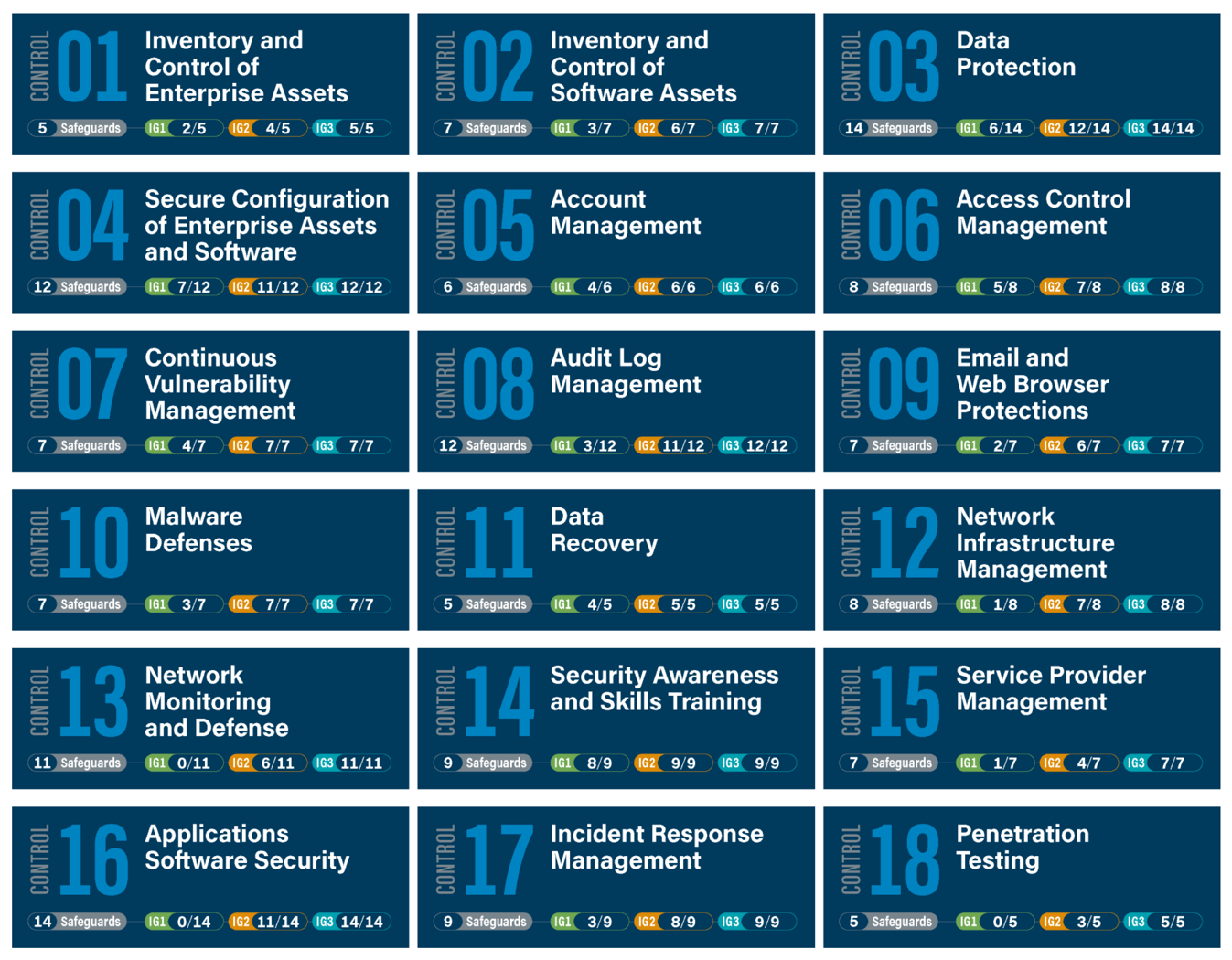
In CIS 8 the number of controls is reduced to 18 from 20 in CIS 7. CIS 8 contains 153 Safeguards, which were called sub-controls in CS7 and they were 171 sub-controls
You’ll Learn:
CIS Security areas to assist you in preparing cloud security architecture
In Part 1 (Session no 95)
- What is the role of CIS and how it is playing to ensure secure internet
- What are CIS Benchmarks & benefits?
- What are the seven core categories of CIS Benchmarks?
- Basics of CIS Controls 7 & CIS Controls 8
- What different cloud vendors provide you to meet CIS Benchmarks?
In Part 2 (Session no 96)
- What are the 18 conrols of the version CIS 8
Resources:
- 95- Cloud Security with CIS Benchmarks
- Center for Internet Security
- CIS Benchmarks
- The 18 CIS Controls
- CSOonline “The 15 biggest data breaches of the 21st century.”
- 5 of the Top Questionnaires for IT Vendor Assessments
- CIS Foundations Benchmark for Oracle Cloud
- 94- How to develop a cloud migration strategy?
- 93- Cloud Migration Workload Assessment
- 91- Workload Migration to Cloud – Getting Started
To share your thoughts:
- Leave a comment on the section below on this post
- You want to suggest any new topic we should cover in future Podcast
- Join us in the Mastermind tribe
- Share this on Twitter, Facebook, If you enjoyed this episode and we together are learning new technologies.
To help out this initiative:
- Leave a candid review for the OTechTalks Podcast on iTunes! Your ratings and reviews will help the session on iTunes.
- Subscribe to the Podcast on iTunes to get the next sessions