Navigating the AI Implementation Journey
This is a continuation of conversations at GITEX, the region’s largest technology conference; several questions and discussions were exchanged while interacting with many folks during the GITEX. I have covered typical questions asked last week, and I can relate to those we covered in our earlier edition: How do I get started with AI? Where can AI deliver the most value? And How do I scale and operationalize AI?
This week, I wanted to address another set of questions received from an audience during the event. Most of the folks I met were trying to explore how to drive or intake AI from the ERP application’s point of view.
Here are my two cents on this topic.
Organizations typically need to go through stages of adopting and integrating AI and Generative AI, starting with simple adoption and moving toward advanced development.
It’s similar to how quickly someone can take on a pilot project in the organization or division.
You can go through the three phases: Adopt, Buy, and Build, each representing a different approach to leveraging AI.
The diagram outlines three stages for organizations to adopt AI, moving from simplicity to deeper integration derived from Deloitte Forum 2023 Gen AI and McKinsey’s Take, Shape, and Make concept:
This approach balances simplicity with increasing complexity and strategic business impact as organizations evolve in their AI journey. From using embedded AI features in existing SaaS applications and extending capabilities with specialized AI Services / Generative AI to creating custom AI models, the progression emphasizes a shift from simplicity and cost-efficiency to maximizing business value and ensuring governance.
This structured path helps organizations align their AI strategy with their growth objectives.
To start following the above approach, refer to the detailed article “Simplified Architecture Was Designed to Take up Generative AI in Cloud Applications.” This architecture followed the approach of Just Enough or Good Enough Enterprise Architecture (EA).
Let’s start with the three-part series covering the three stages of the AI Implementation Journey.
- Adopt (Takers): Leverage AI features embedded in existing SaaS applications, focusing on ease and low costs.
- Buy (Shapers): Expand AI capabilities using a Generative AI portfolio, aiming to extend functionalities.
- Build (Makers): Develop and train custom Generative AI models, focusing on business value and governance
The first part will be covered in this week’s edition, and the remaining two will follow during the next two weeks.
Adopt (Takers):
This is an easy intake and quick way to start the AI journey in the organization. You only need to explore your current footprint of an application.
For example, if you are using Oracle SaaS applications, which have released 100+ AI, Gen AI Agents features as part of the standard product offerings, your task is to go through them individually, map them to your organization’s benefits, and start using them.
Let’s explore it further. Generative AI in Fusion applications targets three areas: 1 – Assisted Authoring, 2 – Suggestions, and 3 – Summarization.
Users retain complete control when using generative AI in Fusion Applications. These AI-driven features activate only upon user request via the AI Assist button. Content generated within the application can be reviewed, modified, or disregarded as needed.
Here’s a simple breakdown of how the process works:
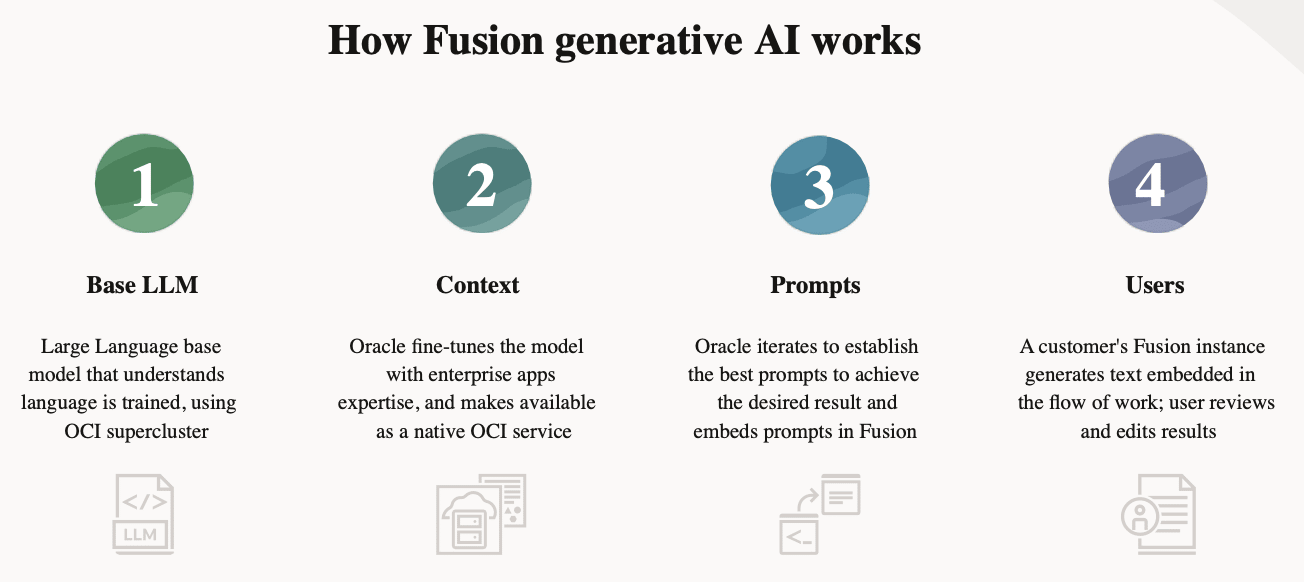 Source: Unleashing the potential of generative AI directly within Oracle Fusion Cloud Applications Suite Source: Unleashing the potential of generative AI directly within Oracle Fusion Cloud Applications Suite |
Oracle Fusion AI Agents: AI agents integrate large language models (LLMs) with other tools and technologies, enabling them to perform complex tasks traditionally handled by humans. These agents interact with their surroundings to collect information, identify the necessary steps to meet specific goals, and act in designated roles. They can plan, access various tools and data, make autonomous decisions, and even collaborate with other AI agents to achieve their objectives.
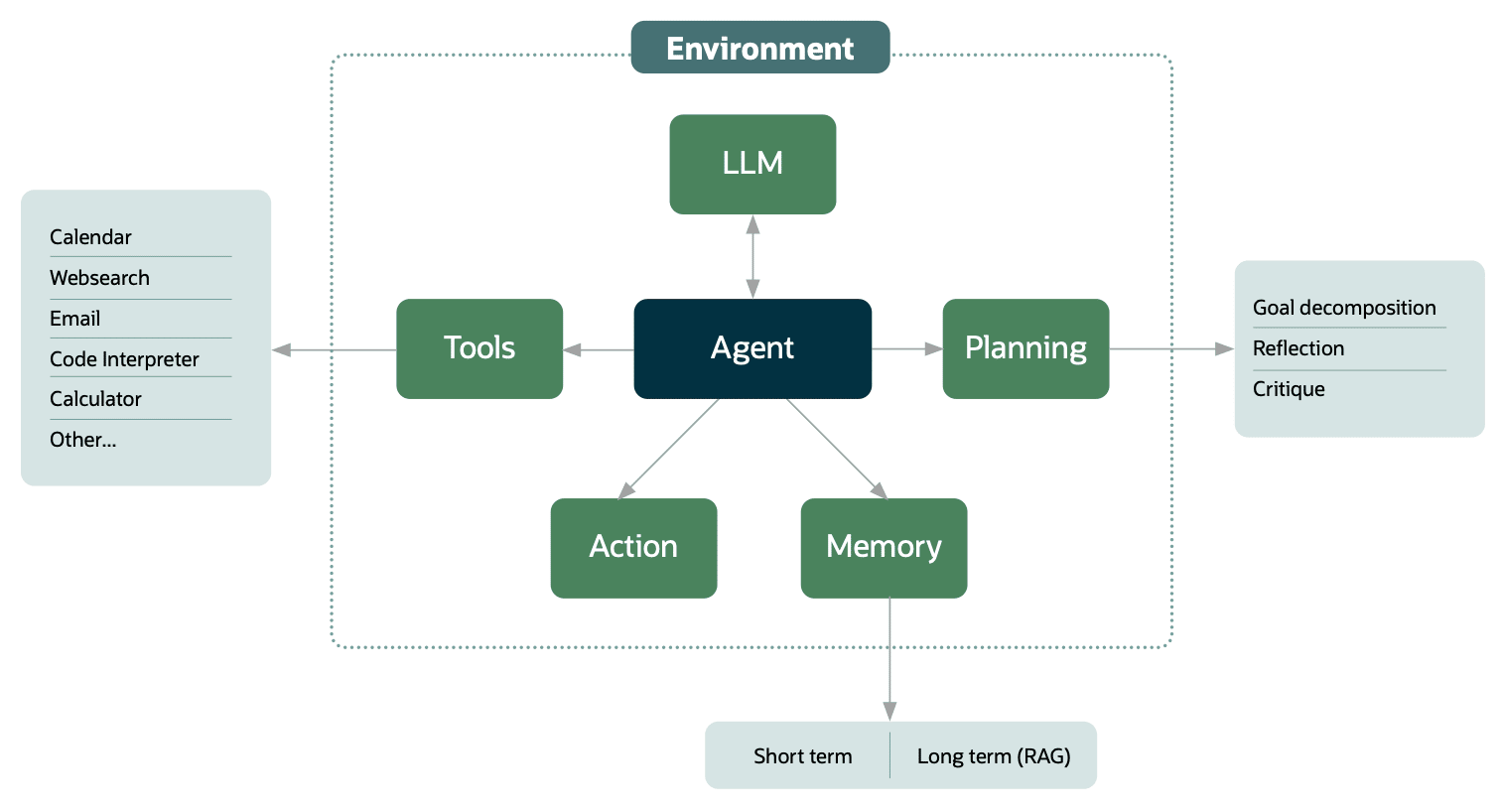 Source: An Introductory Guide to Oracle Fusion AI Agents Source: An Introductory Guide to Oracle Fusion AI Agents |
Oracle’s initial RAG (Retrieval-Augmented Generation) agents in the Fusion Applications are just the beginning. The AI Agents are categorized into Supervisory, Conversational, Functional, and Utility agents who work together to achieve specific tasks or outcomes. In practice, these agents interact, leverage tools, retrieve data, make decisions, and coordinate efficiently to accomplish shared tasks.
For example, Agents for hiring managers can streamline recruitment by documenting essential requirements, such as desired skills and experience, to aid hiring decisions. It also reviews job postings generated by GenAI systems to ensure accuracy and relevance.
A utility agent can do a specific function or tool and is activated by other agents to complete tasks, such as querying a database, sending emails, performing calculations, or retrieving documents.
The Buy (Shapers) and Build (Makers) parts will be covered in the next two weeks.
I’d love to hear your insights and experiences regarding the route you’re taking on your AI journey.
Your feedback is invaluable!